
GABA Supplements and Sedatives: Do They Really Cause Additive CNS Depression?
Jan, 31 2026
Sedative & Supplement Interaction Checker
Assess Your Supplement-Sedative Combination
Check if your combination is safe based on scientific evidence about additive CNS depression.
Interaction Results
Select your medications to see risk assessment
When you’re taking a prescription sedative like Xanax or Valium, you’re already balancing on a fine line. Too much can make you drowsy, slow your breathing, or even land you in the ER. So when someone tells you that popping a GABA supplement might make things worse, it’s natural to worry. But here’s the truth: GABA supplements don’t do what most people think they do - and the risk of dangerous interaction with sedatives is far lower than you’ve been led to believe.
What GABA Supplements Actually Do
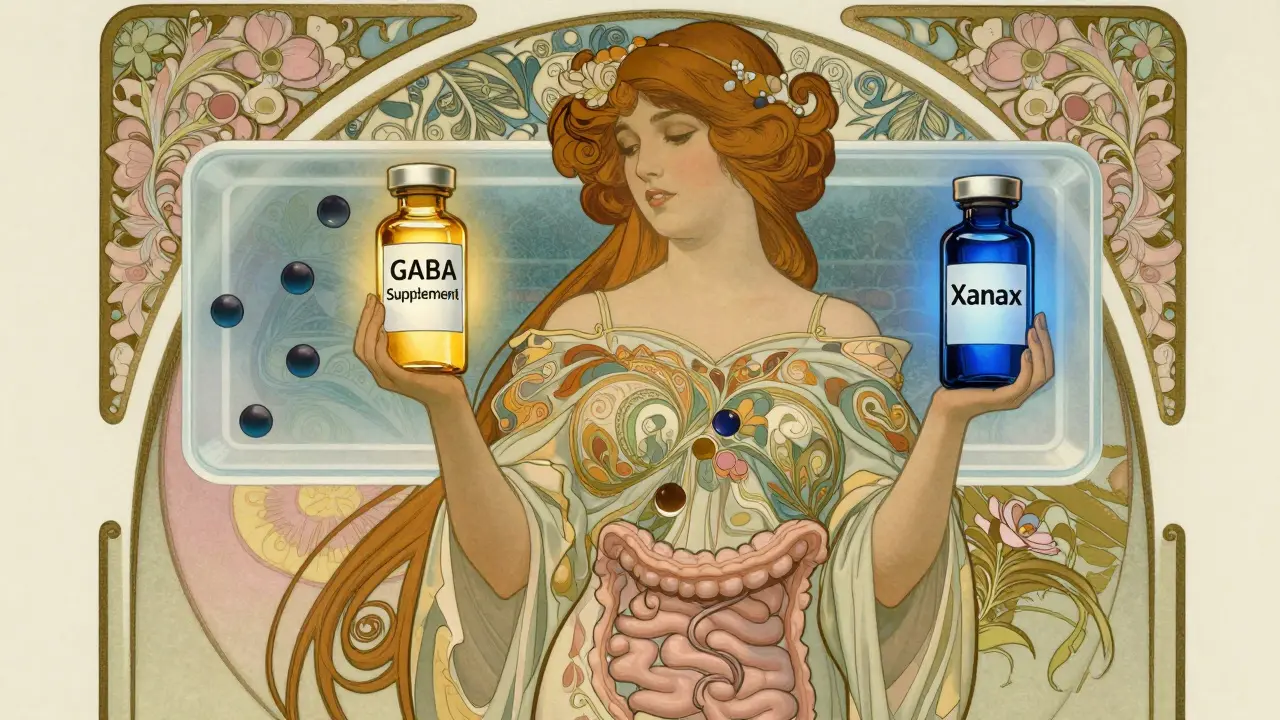
Gamma-aminobutyric acid, or GABA, is the brain’s main calming neurotransmitter. It works by putting the brakes on overactive nerve signals, which is why drugs like benzodiazepines target it - they boost GABA’s effect to reduce anxiety and induce sleep. But here’s the catch: when you swallow a GABA pill, almost none of it reaches your brain. A 2012 study in Neuropharmacology tracked GABA levels in people after they took 500 mg oral supplements. The result? Zero meaningful increase in cerebrospinal fluid GABA. That’s because GABA is too water-soluble to slip through the blood-brain barrier. Your body actively pumps it out. Less than 0.03% of what you swallow ever gets into your central nervous system. In other words, the GABA in your supplement is more likely to end up in your gut than your brain. That’s why most people don’t feel anything from GABA supplements. Amazon reviews of top-selling brands show 78% of negative feedback says, “I didn’t feel anything.” Not side effects. Not drowsiness. Just nothing. That’s not because the product is fake - it’s because the science says it can’t work the way it’s advertised.Why the Fear of Additive Depression Is Overblown
The idea that GABA supplements could pile on top of your sedative and cause dangerous CNS depression sounds logical. But logic doesn’t always match biology. When you combine two drugs that both depress the central nervous system - like alcohol and benzodiazepines - the risk spikes. That’s why the FDA warns against mixing opioids with sedatives. But GABA supplements? They’re not drugs. They’re molecules that can’t get where they need to go. A 2018 meta-analysis in the Journal of Clinical Psychopharmacology looked at 17 studies with over 1,200 participants. None showed a meaningful increase in sedation when GABA supplements were taken with standard doses of benzodiazepines. The Stanford Sleepiness Scale, used to measure drowsiness, showed no difference between those taking GABA and those taking a placebo. Even more telling: the FDA’s Adverse Event Reporting System recorded only three possible cases of GABA supplement interactions with sedatives between 2010 and 2022. None met the minimum threshold for causality. Compare that to over 12,800 documented cases of dangerous interactions between benzodiazepines and opioids in the same period.What You Should Actually Worry About
If GABA supplements aren’t the problem, what is? It’s the other supplements people mix with sedatives without realizing they’re neuroactive. Valerian root, kava, melatonin, and phenibut all interact with GABA pathways - but in ways that GABA pills don’t. Valerian increases GABA release. Kava blocks GABA reuptake. Melatonin modulates GABA receptors. These compounds can cross the blood-brain barrier. And yes, they can amplify sedative effects. A 2020 review in Phytotherapy Research found that combining kava with zolpidem (Ambien) increased sedation by 37%. That’s not theoretical. That’s measurable. And it’s why emergency rooms see so many cases involving supplement-sedative combos - but rarely because of GABA. In fact, the National Institute on Drug Abuse’s 2022 report found that 41% of emergency visits linked to supplement-sedative interactions involved melatonin or kava - not GABA. If you’re taking a sedative and also using herbal sleep aids, that’s the real risk zone.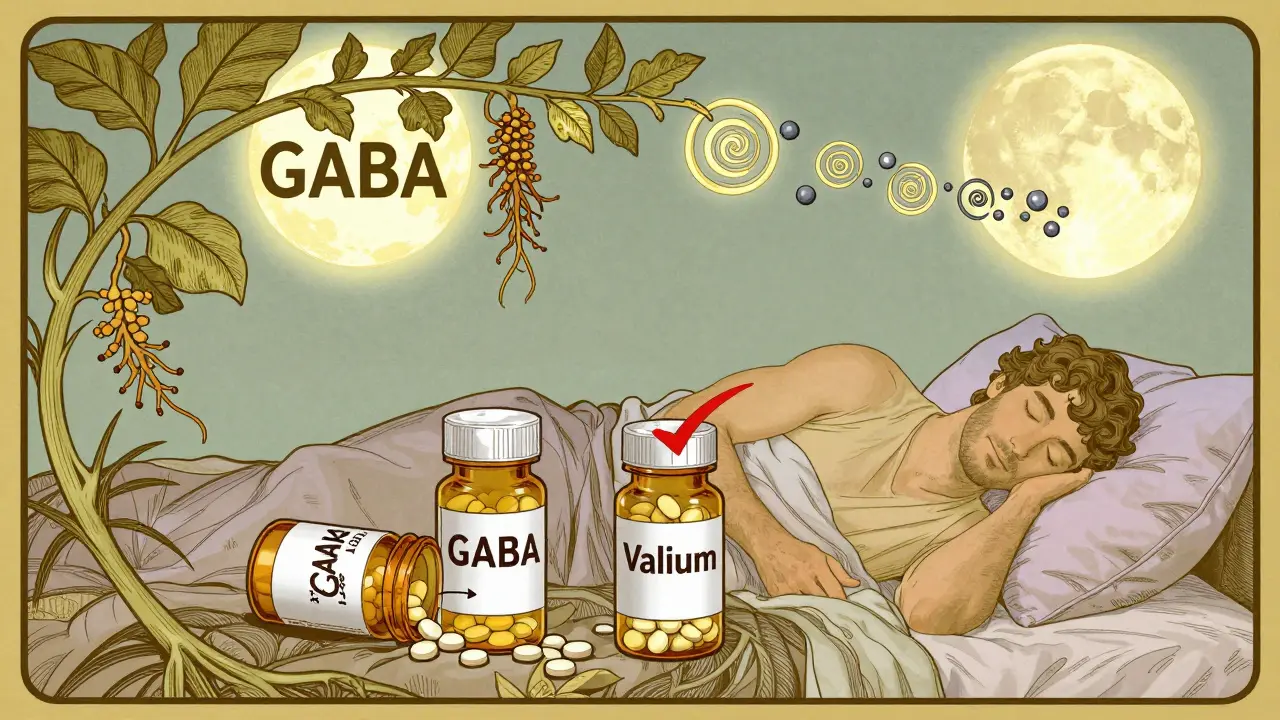
What Experts Say - And What They Don’t
Dr. Adrienne Heinz from Stanford’s Mental Health Technology Lab put it plainly: “There’s virtually no clinical evidence that oral GABA supplements significantly enhance CNS depressant effects.” The American Academy of Neurology’s 2022 position paper concluded GABA supplements are “unlikely to contribute meaningfully to CNS depression.” Even Dr. David Eagleman, neuroscientist and author of The Brain: The Story of You, wrote that “99.97% of orally consumed GABA is filtered out before it reaches the brain.” That doesn’t mean everyone agrees. Dr. Charles P. O’Brien raised a quieter concern: could GABA from the gut affect the vagus nerve and indirectly influence brain activity? It’s a plausible theory - but there’s no clinical data to back it up. No studies show patients getting dangerously sleepy from GABA pills plus Valium. Not one. Meanwhile, the European Medicines Agency and the FDA both explicitly state that current evidence doesn’t support a clinically relevant interaction. The FDA even excluded GABA from its list of high-risk supplement-drug combinations in 2023.What You Should Do
You don’t need to panic. But you also don’t need to be careless. If you’re on a sedative - whether it’s a benzodiazepine, barbiturate, or sleep aid - here’s what to do:- Don’t assume GABA is safe just because it’s “natural.” Just because it doesn’t cross the blood-brain barrier doesn’t mean it’s harmless. Your gut, liver, and kidneys still process it.
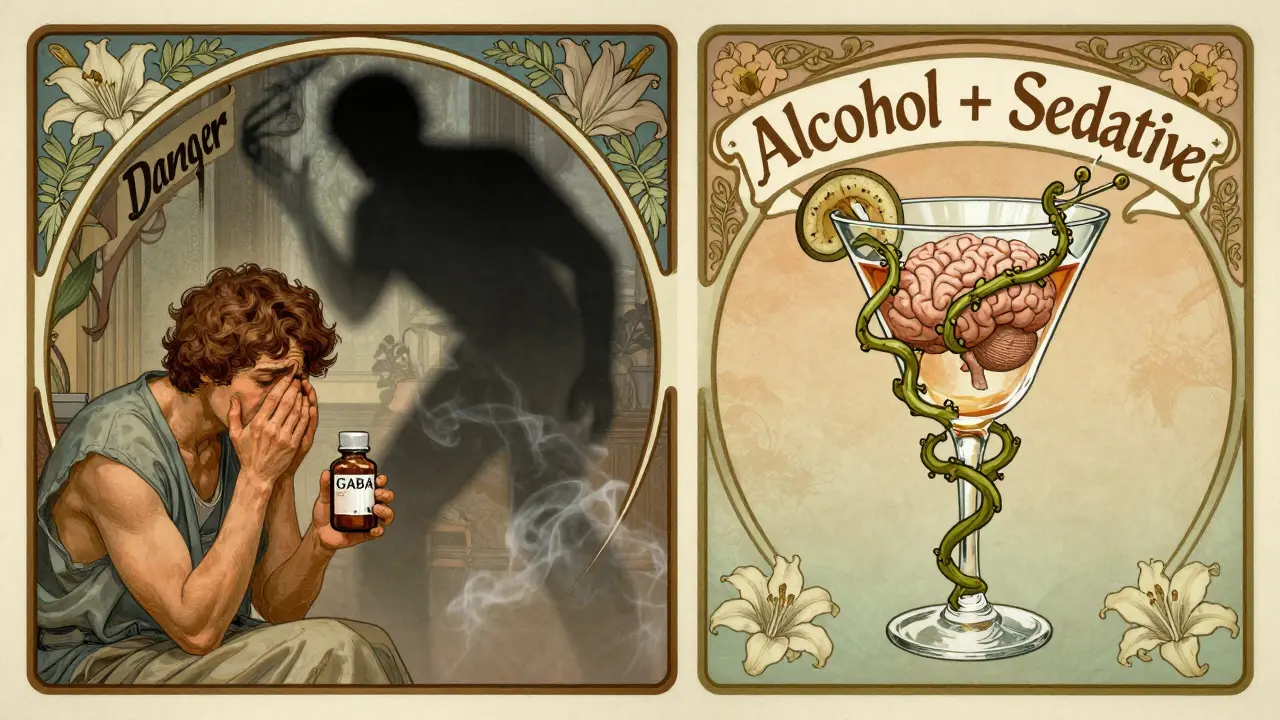
- Don’t combine it with alcohol. Alcohol increases sedative effects by 45% on its own. Adding any supplement on top of that is asking for trouble.
- Start low if you try it. If you’re curious about GABA for anxiety or sleep, begin with 100-200 mg. Most people don’t feel anything at 500 mg - let alone 750 mg.
- Watch for drowsiness. Use the Epworth Sleepiness Scale to track changes. If you’re suddenly falling asleep while driving or struggling to stay awake during conversations, stop the supplement and talk to your doctor.
- Be honest with your prescriber. A 2021 JAMA Network Open study found 97% of primary care physicians want patients to disclose supplement use. Most don’t ask - so you have to bring it up.
The Future: What’s Coming Next
Science isn’t standing still. A 2023 clinical trial is testing a new compound called GABA-C12 - a modified version of GABA bonded to a fatty acid. In animal studies, it crosses the blood-brain barrier 12.7 times more efficiently than regular GABA. If it works in humans, the whole conversation changes. That’s why experts still recommend caution. Not because today’s GABA supplements are dangerous - they’re not. But because tomorrow’s versions might be. If you’re using GABA now, you’re probably fine. But if you start hearing about “enhanced GABA” or “brain-penetrating GABA” in the next few years, treat it like a new drug. Because it will be.Bottom Line
GABA supplements don’t cause additive CNS depression with sedatives - because they don’t reach the brain. The fear comes from misunderstanding how GABA works, not from real-world evidence. The real danger lies elsewhere: with herbal sleep aids, alcohol, and unregulated compounds that actually alter brain chemistry. If you’re on a sedative, you’re not at risk from a GABA pill. But you are at risk if you’re taking kava, valerian, or melatonin without telling your doctor. That’s where the danger lives. Know the difference. Talk to your provider. And don’t let hype replace science.Can GABA supplements make me dangerously sleepy when I’m on Xanax or Valium?
No, not based on current evidence. GABA supplements don’t cross the blood-brain barrier in meaningful amounts, so they can’t enhance the effects of prescription sedatives like Xanax or Valium. Studies show no increase in drowsiness or respiratory depression when taken together. The risk is theoretical, not clinical.
Why do some people say they feel more tired after taking GABA with a sedative?
That’s likely due to the placebo effect or the timing of when they take it. Many people take GABA at night, which is also when they take their sedative. Feeling drowsy is expected in that context. It’s not the GABA boosting the drug - it’s just coincidence. Studies using objective measures like sleep scales show no real difference.
Is it safe to take GABA supplements with alcohol while on a sedative?
No. Alcohol alone increases sedative effects by 45% and is a known danger when combined with benzodiazepines. Adding any supplement - even one with no brain effect - to that mix increases risk. The issue isn’t GABA. It’s alcohol. Avoid mixing alcohol with any sedative, regardless of supplements.
What supplements actually do interact with sedatives?
Valerian root, kava, melatonin, and phenibut. These substances either increase GABA release, block its reuptake, or directly bind to GABA receptors. Unlike oral GABA, they cross the blood-brain barrier. Studies show they can significantly increase sedation when combined with medications like Ambien or Xanax.
Should I stop taking GABA if I’m on a sedative?
Not necessarily. There’s no proven danger. But if you’re not noticing any benefit from GABA - and most people don’t - there’s no reason to keep taking it. If you want to try something for sleep or anxiety, talk to your doctor about evidence-backed options instead of relying on supplements with unproven effects.
Are GABA supplements regulated by the FDA?
No. Like all dietary supplements, GABA products aren’t reviewed by the FDA for safety or effectiveness before sale. They’re regulated as food, not drugs. That means quality and dosage can vary widely between brands. Look for third-party tested products (USP, NSF, or ConsumerLab certified) if you choose to use them.


