
Chronic Bronchitis vs. Emphysema: Key Differences in COPD

Feb, 24 2026
When people talk about COPD, they often treat it like one disease. But that’s not accurate. Chronic bronchitis and emphysema are two very different conditions that both fall under the COPD umbrella - and knowing the difference can change how you manage your health. If you’re breathing harder than you used to, coughing up mucus, or struggling to walk up stairs without stopping, it matters whether this is coming from damaged airways or destroyed lung tissue. The treatment, the outlook, and even how you feel day to day depend on which one you’re dealing with - or if it’s both.
What Exactly Is Chronic Bronchitis?
Chronic bronchitis isn’t just a bad cough. It’s defined by a productive cough - meaning you’re bringing up mucus - that lasts at least three months a year for two years in a row. That’s the clinical standard set by the American Thoracic Society in 2023. It’s not something you shake off after a cold. This is long-term, persistent, and it’s driven by inflammation in your airways.
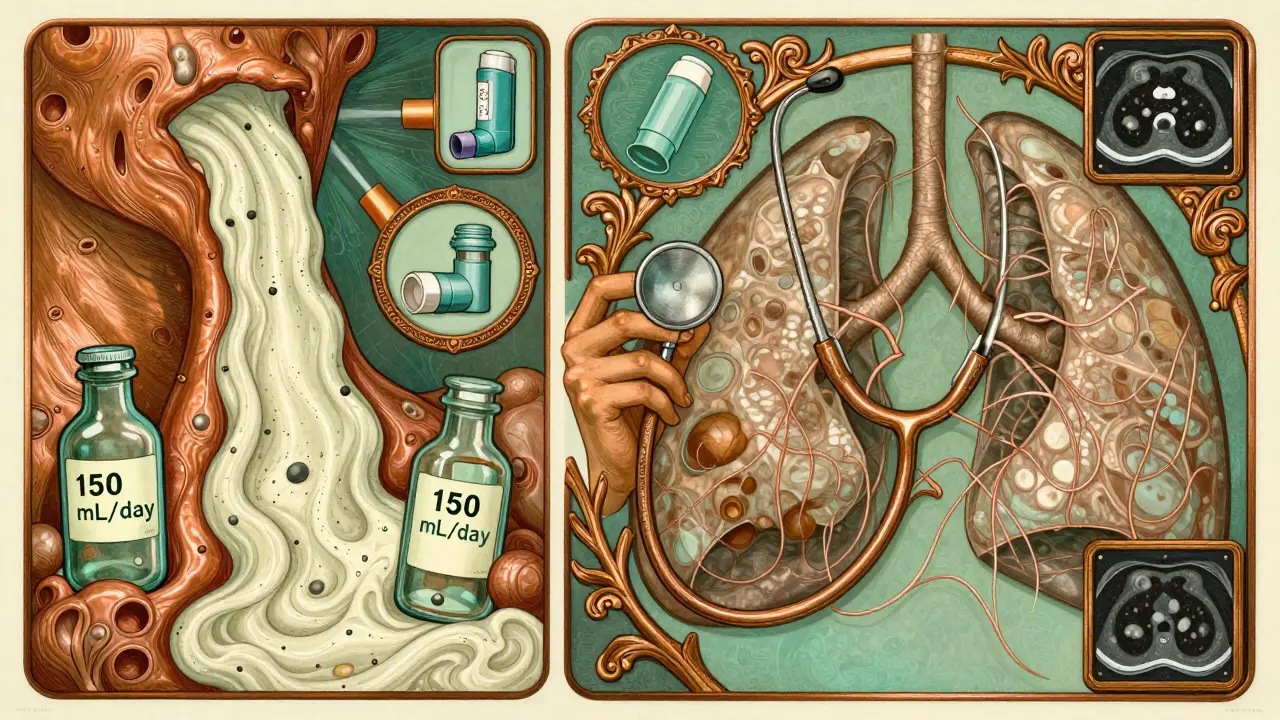
Inside your lungs, the cells that normally produce mucus - called goblet cells - multiply out of control. In chronic bronchitis, you can see a 300% to 500% increase in these cells. The glands under the lining of your bronchial tubes also swell up, producing way more mucus than your lungs can clear. Normal lungs make about 10 to 100 milliliters of mucus a day. Someone with chronic bronchitis? They’re producing 100 to 200 mL. That’s like filling a small water bottle every single day.
And because the tiny hair-like structures called cilia - which normally sweep mucus out - get damaged from smoking or pollution, that mucus just sits there. It clogs the airways. That’s why so many people with chronic bronchitis feel like they’re constantly clearing their throat or have that heavy, wet feeling in their chest. It’s not just annoying - it’s dangerous. Mucus buildup increases infection risk. Studies show 68% of patients have flare-ups during winter months, often triggered by viruses.
People with this form of COPD often look like what doctors call “blue bloaters.” That’s because they’re not getting enough oxygen. Their blood oxygen levels drop to 85-89%. Their lips or fingertips might turn slightly blue (cyanosis), and they often develop swelling in their ankles from heart strain - a condition called cor pulmonale. Their breathing feels tight and labored, but they don’t usually feel like they can’t catch their breath unless they’re moving. The real problem? The mucus.
What Exactly Is Emphysema?
Emphysema is the silent destroyer. You don’t cough up mucus. You don’t necessarily feel congested. But you can’t get enough air. The damage happens deep in the lungs, where the tiny air sacs - alveoli - break down. These sacs are supposed to stretch and recoil like balloons, helping you pull in oxygen and push out carbon dioxide. In emphysema, the walls between the sacs collapse. They merge into large, inefficient spaces. This isn’t just a small loss - advanced cases lose 30% to 50% of their lung’s natural elastic recoil.
Think of it like a sponge that’s been stretched too many times. It doesn’t snap back. When you exhale, the air gets trapped. That’s why people with emphysema often sit with their arms propped up on a table or knees - to help their diaphragm work better. They breathe faster, too. Respiratory rates can hit 25 to 30 breaths per minute just to stay oxygenated.
They’re the “pink puffers.” Their skin stays pink because they’re hyperventilating - forcing air out to keep oxygen levels up. But their body pays a price. Their chest becomes barrel-shaped. The front-to-back diameter of their ribcage widens. Their lungs are overinflated, visible on a CT scan as areas of low density covering more than 15% of lung volume. Their oxygen levels might stay normal (92-95%) because they’re working so hard - but they’re exhausted.
Emphysema patients describe it as “air hunger.” One patient on Reddit said, “I can only say five words before I need to stop and breathe.” That’s not exaggeration. It’s measurable. In advanced cases, the ability of the lungs to transfer oxygen into the blood - called DLCO - drops below 60% of what’s normal. That’s a red flag for emphysema.
How Doctors Tell Them Apart
It’s not enough to just describe symptoms. Doctors need hard data. Pulmonary function tests are the gold standard. The key number? The FEV1/FVC ratio. If it’s below 70%, you have airflow obstruction - that’s COPD. But here’s where the split becomes clear.
Chronic bronchitis shows high airway resistance. Your FEV1 might be low, but your DLCO - the test that measures how well oxygen moves into your blood - stays normal or only slightly reduced. That’s because your alveoli are still mostly intact. The problem is the tubes.
Emphysema? DLCO drops hard - often below 60%. That’s because the air sacs are gone. You can’t transfer oxygen, no matter how hard you breathe. A CT scan confirms it: patches of destroyed lung tissue, especially in the upper lobes. In chronic bronchitis, the CT shows thickened airway walls - over 60% of the airway’s area is taken up by wall tissue instead of open space.
The 6-minute walk test also tells the story. Emphysema patients usually drop their oxygen saturation below 88% within two minutes. Chronic bronchitis patients don’t drop as much - but they stop walking because they feel out of breath, not because they’re oxygen-starved. They’re tired from fighting the mucus.
Treatment Isn’t One-Size-Fits-All
One of the biggest mistakes in COPD care is treating everyone the same. A 2022 study in the New England Journal of Medicine found that patients who got treatment matched to their specific COPD component had 27% fewer hospital stays. That’s huge.
For chronic bronchitis, the goal is to reduce mucus and prevent infections. Mucolytics like carbocisteine are proven to reduce exacerbations by 22%. Hypertonic saline nebulizers - a saltwater mist you inhale - help thin mucus. A 2022 European study found 73% of patients felt it was easier to clear their lungs. And if you have more than two flare-ups a year, roflumilast (a pill that reduces airway inflammation) cuts exacerbations by 17.3%.
But here’s the catch: Inhaled steroids - often given for asthma - can actually increase pneumonia risk by 40% in chronic bronchitis patients. That’s why guidelines now recommend starting with LAMA/LABA combinations (long-acting bronchodilators) instead.
Emphysema is different. The focus is on reducing trapped air. Bronchodilators help, but surgery can too. Endobronchial valve placement - inserting tiny one-way valves into the lungs - helps deflate overinflated areas. The 2021 IMPACT trial showed a 35% improvement in how far patients could walk in six minutes. Lung volume reduction surgery works too - and emphysema patients respond 35% better to it than those with bronchitis.
For the 1-2% of emphysema patients with alpha-1 antitrypsin deficiency - a genetic condition - weekly infusions of the missing protein can slow lung damage. And in 2023, the FDA approved the first inhaled version, offering a less invasive option.
What Patients Actually Live With
Real-life experience doesn’t always match textbook descriptions. On the COPD Foundation’s patient network, emphysema patients report more trouble with physical activity - 78% say they limit their movement - but fewer nighttime disturbances. Only 41% wake up gasping.
Chronic bronchitis patients? Sixty-seven percent say they wake up coughing or choking on mucus. One man in a Reddit thread said he measures his morning phlegm in a cup - 100 mL every day for eight years. That’s not unusual. It takes 20-30 minutes of chest physiotherapy just to clear it.
Both groups struggle with medication routines. Sixty-eight percent of chronic bronchitis patients say juggling four to six inhalers a day is overwhelming. Emphysema patients, meanwhile, say oxygen tanks limit their freedom - even portable ones that deliver 2-4 liters per minute feel bulky and awkward.
But there’s hope. New devices are emerging. A 2024 European acoustic device that vibrates the chest to loosen mucus reduced exacerbations by 32%. For emphysema, bronchoscopic thermal vapor ablation - a procedure that shrinks damaged lung tissue - showed 78% success at two years.
The Bigger Picture
The truth? Most people with advanced COPD have features of both. A 2022 study found only 15% of patients had a pure phenotype. The rest are a mix - which is why some doctors say the “pink puffer” and “blue bloater” labels are outdated.
Still, even if you have both, knowing which one is driving your worst symptoms changes your treatment. If your main issue is mucus, focus on mucolytics. If you’re gasping for air even at rest, lung volume reduction might be worth exploring.
The global COPD market is now $12.8 billion, and drug companies are finally designing treatments for specific phenotypes. Ensifentrine, a new drug for chronic bronchitis, hit $142 million in sales in 2023. Endobronchial valve procedures in the U.S. jumped 22% last year.
And the future? The NIH is launching a major study through 2026 to find blood biomarkers that predict who will respond to which treatment. The goal isn’t just to manage COPD - it’s to treat it like two separate diseases. Because, in many ways, they are.
Can you have chronic bronchitis without emphysema?
Yes. While most people with COPD have some overlap, it’s possible to have chronic bronchitis without significant emphysema - especially in early stages or among long-term smokers who haven’t yet developed alveolar destruction. The key is the persistent productive cough with normal or near-normal DLCO on lung tests.
Can emphysema be reversed?
No, the destroyed lung tissue in emphysema cannot regenerate. But its progression can be slowed dramatically with smoking cessation, oxygen therapy, and targeted treatments like endobronchial valves or alpha-1 augmentation. Some procedures can remove or shrink damaged areas, improving breathing even if the damage itself isn’t undone.
Is COPD the same as asthma?
No. Asthma is typically reversible airway narrowing caused by inflammation and muscle tightening, often triggered by allergens. COPD is progressive, mostly caused by long-term exposure to irritants like smoke, and involves permanent structural damage - either to the airways (bronchitis) or air sacs (emphysema). Asthma usually starts younger; COPD shows up after age 40.
Do I need a CT scan to diagnose emphysema?
Not always. A simple lung function test with DLCO measurement can strongly suggest emphysema if the value is below 60% of predicted. But a high-resolution CT scan is needed to confirm it, see the exact location and extent of damage, and determine if you’re a candidate for surgery or valve placement.
Why does my doctor keep asking about mucus?
Because mucus tells them if you have chronic bronchitis - and that changes your treatment. If you’re coughing up phlegm daily, you may benefit from mucolytics or roflumilast. If you’re not, your care might focus more on lung volume reduction or oxygen therapy. Mucus is a key clue to which part of COPD you’re dealing with.
What to Do Next
If you’ve been diagnosed with COPD and aren’t sure whether you have more bronchitis or emphysema, ask your doctor for your DLCO results. If they don’t have it, request it. Ask if you’ve had a high-resolution CT scan. If not, find out if you’re a candidate. Bring a log of your symptoms: How often do you cough up mucus? Do you feel out of breath at rest? Do you wake up gasping? That information matters.
And if you’re still smoking - stop. No treatment works as well as quitting. The damage may be done, but stopping slows everything down. Talk to your doctor about support programs. You’re not alone. There are now over 200 local COPD support groups across the U.S., and online communities where people share real advice - not just textbook facts.


