
Do Doctors Know How Much Drugs Cost? The Hidden Gap in Prescribing Decisions
Dec, 31 2025
When a doctor writes a prescription, they rarely know how much the patient will actually pay at the pharmacy. It’s not because they don’t care-it’s because the information isn’t there. For decades, clinicians have been expected to choose the best drug for a patient’s condition, but the price tag? That’s left to the patient to figure out. And the result? Patients skip doses, split pills, or go without meds altogether-not because they’re noncompliant, but because they can’t afford what’s on the script.
The Numbers Don’t Lie
A 2007 review of 29 studies found that doctors consistently misjudged drug prices. They overestimated the cost of cheap generic drugs by 31% and underestimated expensive brand-name drugs by 74%. That’s not a small error-it’s a massive blind spot. Even worse, only 31% of doctors accurately guessed the price of low-cost medications. Meanwhile, 74% got high-cost drugs right, not because they knew the price, but because they assumed anything expensive must be expensive. It’s guesswork dressed up as clinical judgment. A 2016 study of 254 medical students and doctors showed just how bad it is: only 5.4% of generic drug costs and 13.7% of brand-name drug costs were estimated within 25% of the actual price. For nearly 80% of generics, doctors thought they cost more than they did. For more than half of brand-name drugs, they thought they cost less. And only 30% of all dispensing costs were estimated correctly.Why Does This Matter?
In 2022, Americans spent $621 billion on prescription drugs-nearly 10% of all healthcare spending. Nearly 1 in 4 adults say they’ve skipped a dose or not filled a prescription because of cost. That’s not just a personal hardship-it’s a public health crisis. And doctors are often the last to know. Consider this: a patient with high blood pressure is prescribed lisinopril, a generic that costs $4 a month. The doctor thinks it’s $20. They don’t realize how affordable it is. Another patient with diabetes gets a $900-a-month insulin brand because the doctor doesn’t know there’s a $35 generic alternative. The patient can’t afford it. They skip doses. Their A1c climbs. They end up in the ER. The system fails-not because of bad intent, but because of bad information.Who Knows What, and When?
Medical students start out with almost no training in drug pricing. One study found that 56% of U.S. medical schools don’t teach it at all. By the time they become residents, their knowledge improves slightly-but not enough. Median scores on drug pricing knowledge tests hover around 6 out of 10. And even attending physicians, who’ve been prescribing for years, still get it wrong more often than not. Interestingly, doctors who’ve been practicing longer aren’t necessarily better. In fact, younger physicians under 40 are 26% more likely to use cost information when it’s available. Why? Because they’ve trained in a world where digital tools are part of the workflow. Older physicians, used to relying on memory and experience, are slower to adapt.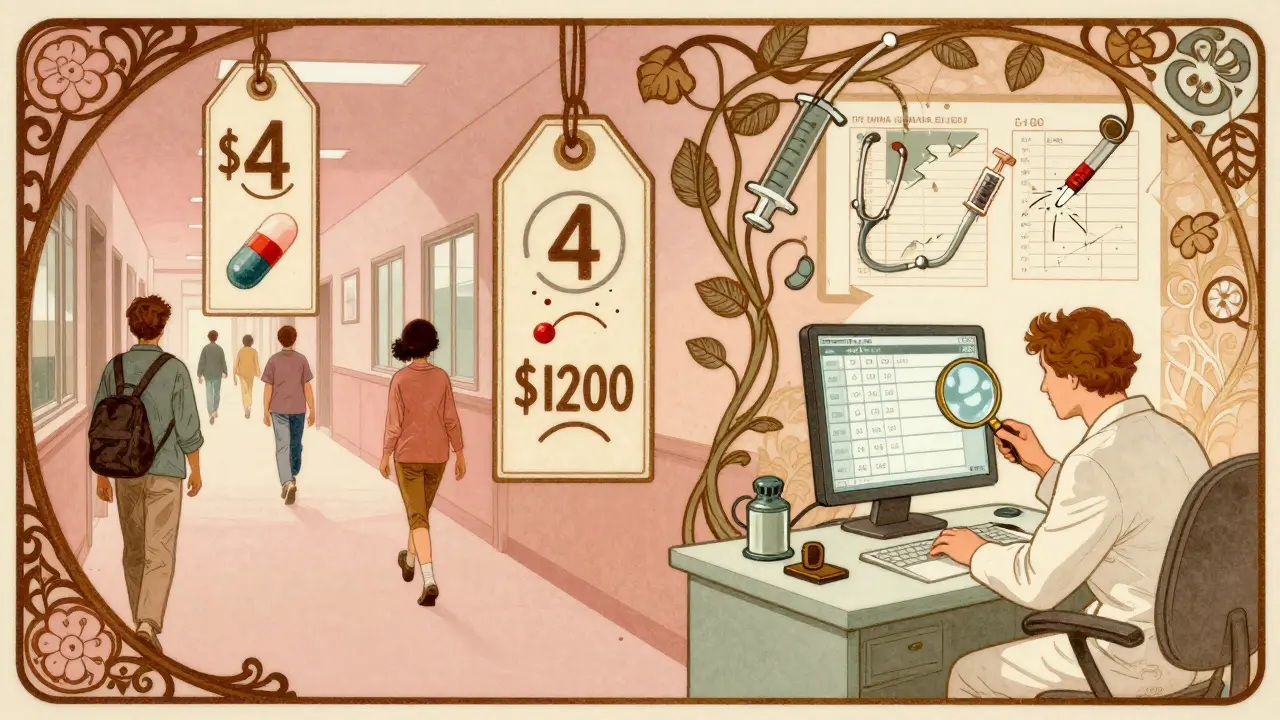
The EHR Revolution-And Its Limits
The biggest breakthrough in closing this gap? Electronic health records (EHRs) that show real-time drug costs at the point of care. A 2021 JAMA Network Open study found that when cost data was embedded in EHRs, doctors made better choices. One in eight changed a prescription after seeing the price. That number jumped to one in six when the potential savings were over $20. UCHealth rolled out a system in 2022 that showed patients’ out-of-pocket costs based on their insurance. Result? Prescription modifications went up by 12.5%. That’s not just a statistic-it’s 12.5% fewer patients stuck with unaffordable meds. But here’s the catch: most of these systems are broken. A resident on Reddit wrote in March 2024 that their Epic system shows insurer pricing, but not their patient’s actual copay. One doctor tried to switch a patient from a $1,200 brand-name drug to a $15 generic-only to find out the patient’s insurance didn’t cover the generic, and the brand was cheaper. The system didn’t know. The doctor didn’t know. The patient paid more.What’s Missing: Value, Not Just Price
Cost awareness isn’t just about knowing the dollar amount. It’s about understanding value. A 2024 American Hospital Association report found that five major drugs saw price hikes in 2023 with no clinical justification. Humira’s price went up 4.7%-even though nothing changed about the drug. Doctors who don’t know this are being misled into thinking higher price = higher benefit. It’s not true. And the system lets them believe it. The Institute for Clinical and Economic Review has been tracking this. Their data shows that most price increases are driven by profit, not innovation. But until clinicians are trained to ask, “Is this drug worth the cost?”-not just “What does it cost?”-we’re treating symptoms, not the disease.Progress Is Real-But Slow
There’s hope. The 2022 Inflation Reduction Act gave Medicare the power to negotiate drug prices. Polls show 80% of Americans support it-regardless of party. That’s rare. And it’s changing the conversation. Hospitals that have implemented real-time benefit tools (RTBTs) report fewer medication non-adherence cases and lower emergency visits. Mayo Clinic’s Drug Cost Resource Guide, updated quarterly since 2019, gets a 4.7/5 rating from its 1,200 physician users. Compare that to the generic Medicare Part D formulary, which scores a 2.8/5. The difference? One is curated, current, and useful. The other is a static list no one trusts. But only 37% of U.S. health systems have even basic cost-alert tools. The rest? They’re flying blind.
The Way Forward
Fixing this isn’t about blaming doctors. It’s about giving them the right tools, at the right time, in the right way.- Integrate real-time, patient-specific cost data into EHRs-not just insurer pricing, but actual copays based on the patient’s plan.
- Teach drug pricing in medical school. Make it as essential as pharmacokinetics.
- Require value assessments alongside cost data. Is this drug better than the alternative? Or just more expensive?
- Standardize pricing data. A drug shouldn’t cost $15 at one pharmacy and $320 at another. That’s not a market-it’s chaos.
What Patients Are Feeling
On Reddit’s r/medicine, a primary care doctor wrote: “Checking drug costs takes 3 to 5 minutes per prescription. Add that to a full clinic day, and you’re adding 30+ minutes of extra work.” That’s real. And it’s why many just skip it. But when the system works, it changes lives. One patient with rheumatoid arthritis was on a $1,400 monthly biologic. Her doctor, using the cost tool, switched her to a $120 generic. She cried. She hadn’t been able to afford it in years. She’s now in remission.It’s Not About Cutting Costs. It’s About Fairness.
Doctors don’t want to be pharmacists. They don’t want to be accountants. But they do want to help patients get better. And if the price of healing is too high, the treatment fails-even if the science is perfect. The gap between what clinicians know and what patients pay isn’t just a data problem. It’s a moral one. And it’s time we closed it.Do doctors know how much drugs cost?
Most doctors don’t know the exact out-of-pocket cost their patients will pay. Studies show they overestimate cheap drugs by 31% and underestimate expensive ones by 74%. Even when they guess the right ballpark, they rarely know what the patient will actually pay due to insurance complexity, pharmacy differences, and lack of real-time data.
Why don’t doctors know drug prices?
Drug pricing is fragmented, opaque, and constantly changing. Prices vary by pharmacy, insurance plan, copay structure, and even the patient’s deductible. Most electronic health records don’t show patient-specific costs, and medical schools rarely teach pricing. Doctors simply don’t have reliable, easy-to-access data at the point of care.
Can EHRs fix the problem?
Yes-but only if they’re built right. EHRs that show real-time, patient-specific out-of-pocket costs have been shown to change prescribing habits. One study found doctors changed prescriptions 12.5% more often when they saw actual costs. But many systems only show list prices or insurer rates, not what the patient pays. That makes them unreliable and often useless.
Are generic drugs always cheaper?
Usually-but not always. Insurance plans sometimes make brand-name drugs cheaper through rebates or preferred tiers. A generic might cost $15, but if the patient’s insurance has a $20 copay for generics and no copay for the brand, the brand is cheaper. Without knowing the patient’s plan, even experts can’t assume generics are the best deal.
What’s being done to improve cost awareness?
The 2022 Inflation Reduction Act allows Medicare to negotiate drug prices, increasing pressure for transparency. Some hospitals, like UCHealth and Mayo Clinic, have built advanced cost tools with real-time data. Medical schools are slowly adding pricing education. But only 37% of U.S. health systems have any kind of cost-alert system, and most still lack patient-specific data.
How can patients help?
Patients can ask: “Is there a cheaper alternative?” or “What will this cost me out of pocket?” Many doctors want to help but don’t have the tools. If patients bring up cost concerns, it gives clinicians the opening they need to look up options. Don’t be afraid to ask-it’s your right.


