
Clinical Trial Eligibility: How Biomarkers and Inclusion Criteria Shape Cancer Treatment

Jan, 13 2026
When you hear about a new cancer drug hitting the market, it’s easy to think it’s just another pill that works for everyone. But the truth is, most of these drugs only work for a small group of people-and that’s by design. Today’s cancer clinical trials don’t just pick patients based on where the tumor is or how advanced it is. They look deeper. They check for biomarkers. These are biological signs in your body-like specific genes, proteins, or cell patterns-that tell doctors whether a drug is likely to help you or not.
What Biomarkers Really Do in Cancer Trials
Biomarkers aren’t magic. They’re measurable things in your blood, tissue, or DNA that give clues about your cancer. The FDA defines them as objective signs of normal biology, disease, or how your body reacts to treatment. In cancer trials, they’re used to decide who gets in-and who doesn’t.
Think of them like a key. Some drugs only unlock their effect when they meet the right key. HER2 in breast cancer. EGFR in lung cancer. BRCA mutations in ovarian and prostate cancer. If your tumor has that exact key, the drug might shrink it. If not, it won’t. That’s why trials now require biomarker testing before you’re even considered.
Between 2017 and 2022, nearly 60% of new cancer drugs approved by the FDA required a biomarker test just to qualify. That’s not a trend-it’s the new standard. And it’s working. Trials that use biomarkers to pick patients have nearly double the chance of getting approved compared to those that don’t. Why? Because they’re not guessing anymore. They’re targeting.
Inclusion Criteria: More Than Just Age and Stage
Inclusion criteria used to be simple: you had to be over 18, have stage III or IV cancer, and be healthy enough to handle treatment. That’s still true-but now it’s layered with biomarkers.
Let’s say you’re looking at a trial for a new drug targeting a specific mutation in non-small cell lung cancer. Your inclusion criteria might say:
- Diagnosed with advanced non-small cell lung cancer
- ECOG performance status of 0 or 1 (meaning you’re fairly active)
- Confirmed presence of an EGFR exon 19 deletion or L858R mutation via validated test
- No prior treatment with an EGFR inhibitor
That last bullet? That’s the biomarker. Without it, you’re automatically out-even if you meet every other condition. That’s how precise this has become.
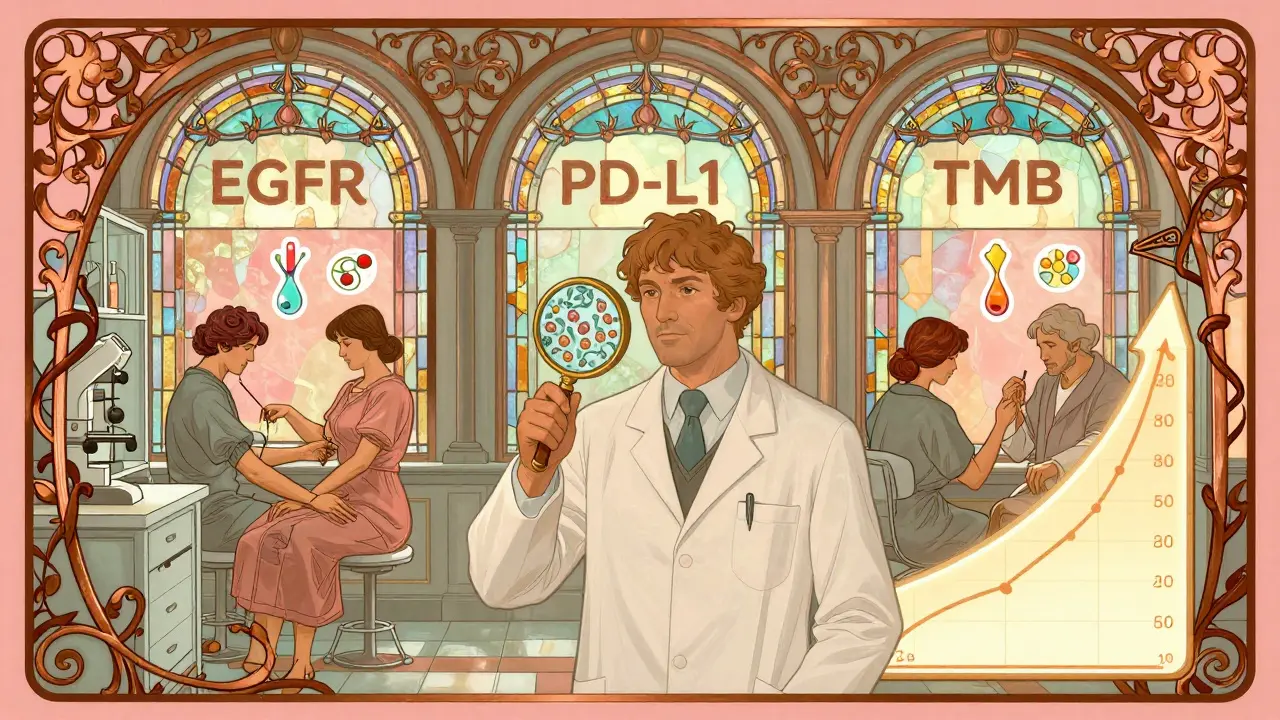
Some trials even use multiple biomarkers. A trial might require both a PD-L1 expression level above 50% and a TMB (tumor mutational burden) over 10 mutations per megabase. These aren’t random numbers. They’re based on years of data showing that patients with both markers respond better to immunotherapy.
The Hidden Cost of Precision: Screening Failure Rates
There’s a catch. The more specific the biomarker, the fewer people qualify.
At MD Anderson Cancer Center, researchers found that in trials for non-small cell lung cancer, biomarker-driven eligibility cut screening failures from 70% down to 35%. That sounds great-until you realize that means 65% of people who showed up for screening still couldn’t join. Why? Because their tumors didn’t have the right mutation.
That’s hard for patients. You travel hundreds of miles, take time off work, get blood drawn, maybe even a biopsy-and then you’re told, “Sorry, your tumor doesn’t match.” It’s not just disappointing. It’s exhausting.
And it’s worse in places with less access to testing. If you live in a rural area or a country without advanced labs, getting a biomarker test can take weeks-or be impossible. One study showed that in some regions, biomarker testing turnaround time is 7 to 14 days. That’s long enough for a cancer to grow, for a patient to lose hope, or for the trial slot to fill up.
How Biomarker Tests Are Validated (And Why It Matters)
Not every test is created equal. A lab in Sydney might use one method to detect a KRAS mutation. A lab in Boston might use another. If the results don’t match, the trial fails.
That’s why the FDA requires rigorous validation. Before a biomarker can be used to decide who gets into a trial, it must pass three tests:
- Analytical validation: Does the test reliably detect the biomarker? Is it accurate every time?
- Clinical validation: Does the biomarker actually predict how a patient will respond to treatment?
- Context of use: Exactly how is this biomarker being used? Is it to select patients? Monitor response? Predict side effects?
These aren’t just paperwork. They’re the difference between a drug that helps and one that’s a waste of time-and money. The European Medicines Agency found that 68% of biomarkers used in early trials don’t even meet basic validation standards. That’s a huge problem. If the test is flawed, the trial is flawed.
That’s why most major trials now use CLIA-certified labs and centralized testing. Blood or tissue samples are shipped to one place, tested the same way, and results are compared fairly. It’s expensive. It’s slow. But it’s necessary.
Real-World Impact: When Biomarkers Save Lives
Let’s talk about real people. In a trial for neratinib, a drug for HER2-positive breast cancer, researchers saw something powerful. In unselected patients-those without biomarker testing-the response rate was 12%. But when they only enrolled patients with confirmed HER2 mutations? The response rate jumped to 32%.
That’s not a small improvement. That’s life-changing. It means more tumors shrink. More patients live longer. More people avoid the side effects of drugs that wouldn’t have worked anyway.
Another example: patients with metastatic melanoma and a BRAF V600E mutation. Before biomarker-based trials, treatment options were limited and harsh. Now, with drugs like vemurafenib and dabrafenib, patients with that specific mutation can live years longer than before. All because they were tested first.
This isn’t theoretical. It’s happening in hospitals right now. And it’s why oncologists say biomarkers are the biggest shift in cancer care since chemotherapy.

The Future: Liquid Biopsies, AI, and Global Access
What’s next? Liquid biopsies. Instead of a needle going into your tumor, they just draw your blood. They look for tumor DNA floating in your bloodstream. It’s less invasive, faster, and can be done repeatedly. In 2023, 31% of Phase 2+ cancer trials used liquid biopsies for biomarker testing-up from just 9% in 2020.
Artificial intelligence is also stepping in. Pharma companies are using AI to find new biomarker patterns in massive datasets. They’re not just looking for one gene-they’re looking at combinations of genes, proteins, and immune signals. By 2025, two-thirds of new trials are expected to use multi-omic panels, not single markers.
But the biggest challenge isn’t science. It’s access. A 2023 survey found that 68% of global trials struggle with geographic differences in biomarker prevalence. HLA-A*02:01, a biomarker used in some cell therapies, is common in Europe but rare in parts of North America. That means a trial that works in Germany might not recruit enough patients in Texas.
Companies are starting to fix this. Some now use centralized labs. Others send standardized kits to clinics worldwide. A few are even testing remote sample collection. But progress is slow. And until biomarker testing becomes as routine as a blood pressure check, many patients will still be left out.
Why This Matters to You
If you or someone you know is considering a cancer clinical trial, here’s what you need to do:
- Ask: “What biomarkers are being tested?”
- Ask: “Where will the test be done? How long will it take?”
- Ask: “What happens if I don’t have the biomarker?”
- Ask: “Can I get a copy of the test results?”
Don’t assume your doctor knows everything. Biomarker testing is complex. You need to be your own advocate. If a trial doesn’t explain its biomarker criteria clearly, walk away. There are others.
And if you don’t qualify now? That doesn’t mean you never will. New biomarkers are discovered every year. Trials are constantly updating. Stay in touch with your oncologist. Ask about future trials. Keep your tissue samples stored if possible-they might be useful later.
This isn’t just about getting into a trial. It’s about getting the right treatment. And that’s what precision medicine is all about: not treating cancer the same way for everyone-but treating your cancer the right way for you.


