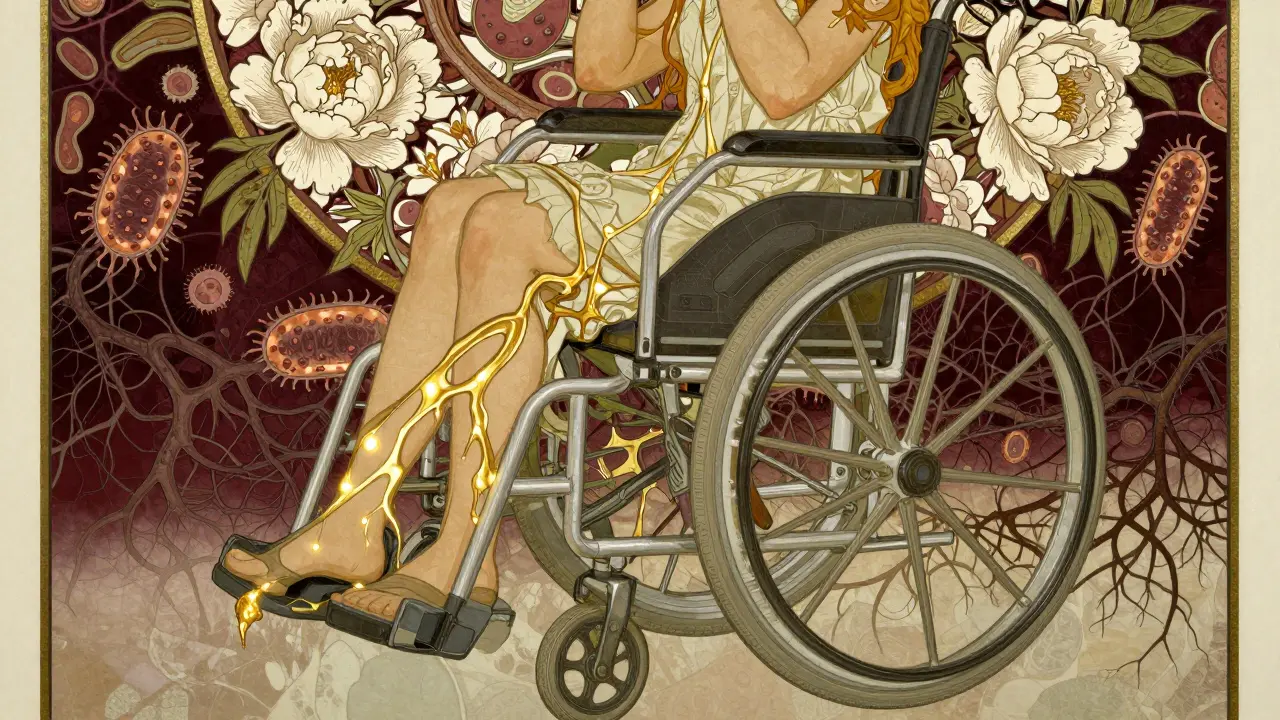
Guillain-Barré Syndrome: Understanding Acute Weakness and IVIG Treatment

Jan, 20 2026
When your legs suddenly feel heavy, then your arms, then your face - and you can’t move them - you don’t just feel sick. You feel trapped in your own body. That’s what Guillain-Barré Syndrome (GBS) does. It’s not a slow decline. It’s a rapid attack. Within days, a person who was walking normally can be paralyzed, needing a ventilator to breathe. And it happens to otherwise healthy people - no warning, no prior illness, just a cold or stomach bug that somehow triggers the immune system to turn against the nerves.
What Happens When Your Immune System Attacks Your Nerves
Guillain-Barré Syndrome is an autoimmune disorder where the body’s defenses, meant to fight infections, mistakenly target the peripheral nerves. These are the nerves outside the brain and spinal cord that control movement, sensation, and even heart rate. In most cases, the immune system goes after the myelin sheath - the fatty coating that insulates nerves and helps signals travel fast. Without it, messages from your brain to your muscles get scrambled or lost entirely. This is why weakness starts in the feet and climbs upward. Eighty-five percent of people with GBS feel it first in their legs - tingling, numbness, then inability to stand or walk. Within a week, it often spreads to the arms, face, and even the muscles that control swallowing and breathing. About half of patients develop facial weakness. Some can’t smile. Others can’t swallow saliva. In 20 to 30 percent of cases, the breathing muscles fail. That’s when you’re rushed into intensive care. The most common form in North America and Europe is called AIDP - Acute Inflammatory Demyelinating Polyradiculoneuropathy. It accounts for 90 percent of GBS cases here. The rest are rarer variants, like AMAN (axonal), which damages the nerve fibers themselves. Doctors diagnose it using nerve conduction tests that show slowed signals, and a spinal tap that reveals high protein levels without many white blood cells - a telltale sign called albuminocytological dissociation.What Triggers Guillain-Barré Syndrome?
GBS doesn’t come out of nowhere. It’s almost always preceded by an infection. The most common trigger in the U.S. is Campylobacter jejuni, a bacteria found in undercooked poultry or contaminated water. About 1 in 5 people who get GBS had a stomach bug from this bug just weeks before symptoms started. Other triggers include the flu virus, Epstein-Barr (mononucleosis), cytomegalovirus, and even Zika virus. In rare cases, surgery or vaccines - like the 1976 swine flu shot - have been linked, but modern vaccines are far safer. The risk of GBS from a flu shot is less than 1 in a million. The real problem is molecular mimicry. Some parts of the bacteria or virus look surprisingly like nerve tissue. The immune system attacks the invader, but then keeps going - mistaking your nerves for the enemy. This is why timing matters. The immune response peaks around 10 to 14 days after the infection. That’s the window when treatment can still make a big difference.IVIG: The Treatment That Slows the Attack
The two main treatments for GBS are intravenous immunoglobulin (IVIG) and plasma exchange. Both work by calming the overactive immune system. But IVIG is now the first choice for most patients. IVIG is made from the pooled antibodies of thousands of healthy donors. When given in high doses - 0.4 grams per kilogram of body weight - over five days, it floods the bloodstream with normal antibodies. These act like decoys. They soak up the bad ones attacking your nerves, preventing further damage. It’s not a cure. It doesn’t repair damaged nerves. But it stops the attack in its tracks. Clinical trials show IVIG cuts recovery time by about half. Patients who get IVIG within two weeks of symptom onset regain the ability to walk about three weeks faster than those who don’t. Sixty percent show improvement within two to four weeks. That’s life-changing. Imagine going from being bedridden to standing with help in under a month. Compared to plasma exchange - which filters your blood through a machine to remove bad antibodies - IVIG is simpler. You don’t need a central line. You don’t need a specialist to run the machine. Just a regular IV in your arm. That’s why most hospitals prefer it. A 2019 study in JAMA Neurology found both treatments worked equally well at four weeks, but patients rated IVIG much higher because it was less stressful and painful.
Cost, Risks, and Limitations of IVIG
IVIG isn’t perfect. It’s expensive. A full course in the U.S. costs between $15,000 and $25,000. That’s why some countries still use plasma exchange - it’s cheaper, though more invasive. Global shortages happened during the pandemic. In 2021, 40 percent of hospitals ran out of supply. That’s when doctors had to make tough choices. Side effects are common. One in four people get a bad headache during or after the infusion. Some feel feverish or nauseous. A small number - 1 to 3 percent - develop blood clots. People with IgA deficiency are at risk of severe allergic reactions. And in rare cases, IVIG can cause kidney damage, especially in older patients or those with diabetes. One parent shared online that their child needed dialysis after the third dose. That’s rare - about 0.5 percent - but it happens. Corticosteroids? They don’t work. Multiple studies have shown steroids don’t speed recovery or improve outcomes. That’s why they’re not recommended. Only IVIG and plasma exchange are proven.What Recovery Looks Like
Recovery isn’t fast. Even with IVIG, it takes months. Most people start to feel better within 10 to 14 days of starting treatment. Tingling fades. Toe movement returns. Then ankle strength. Then standing. Walking takes longer. Some need physical therapy for a year. The data shows: 60 percent of patients recover fully within six to twelve months. Thirty percent have some lasting weakness - maybe foot drop, or trouble climbing stairs. Ten percent remain severely disabled. That’s one in ten. They might need a wheelchair or cane long-term. And 20 percent still have nerve pain, fatigue, or muscle cramps after a year. The key is early treatment. Experts say every day you wait reduces IVIG’s effectiveness by about 5 percent. That’s why doctors push for diagnosis and treatment within 7 to 14 days. After 21 days, the nerve damage becomes harder to reverse.