
How to Reduce Costs for Specialty Medications and Injectables
Mar, 3 2026
Specialty medications and injectables are changing how we treat serious illnesses-cancer, rheumatoid arthritis, MS, and more. But they’re also breaking budgets. These drugs make up just 2% of all prescriptions, yet they eat up 50% of total pharmacy spending. For employers, that’s an average of $34.50 per employee, every month. If you’re managing healthcare costs-whether you’re an employer, a patient, or part of a health plan-you need real ways to cut these costs without cutting care.
Use Formulary Management to Stop Waste Before It Starts
Formulary management isn’t just a buzzword. It’s a system that stops unnecessary or inappropriate use of high-cost drugs before they’re even prescribed. Think of it like a traffic light for prescriptions: green for safe, effective choices; yellow for cases needing review; red for drugs that don’t meet clinical standards.Employers like Excellus BlueCross BlueShield cut GLP-1 weight loss drug costs by $13.64 per member per month just by tightening prior authorization rules. That’s not about denying care-it’s about making sure the right drug is used for the right patient. Step therapy, where patients try a cheaper, equally effective drug first, works too. One study showed that when patients were required to try a biosimilar before jumping to a brand-name biologic, 98% still got approved for their needed treatment-while savings piled up.
But here’s the catch: if your formulary is too strict, people delay care. The key is balance. Use clinical pharmacists to review cases, not automated systems. Build feedback loops with prescribers. Track which drugs are being overused and why. A well-run program doesn’t just save money-it improves outcomes.
Switch to Narrow Pharmacy Networks
Most people don’t realize that where you fill your specialty prescription matters just as much as what you’re taking. Specialty pharmacies aren’t all the same. Some charge 30% more just for the same drug.By limiting your plan to a small network of top-performing specialty pharmacies-like CVS Health or Express Scripts-you can cut costs by 10-15%. CarelonRx found that employers using exclusive networks saved $1.37 per member per month. That’s $35 million a year across 200 employers. Why? Because these networks negotiate lower prices, offer better clinical support, and track adherence more closely.
Yes, some patients hate switching pharmacies. One study showed 22% of employers saw a spike in call center volume during the transition. But the payoff? Higher satisfaction. Patients in preferred networks rated their support services at 8.7/10-compared to 7.2/10 elsewhere. Clear communication helps: send letters, offer phone help, and give patients time to adjust. It’s not about forcing change-it’s about guiding them to better, cheaper care.
Adopt Biosimilars-They’re Not Just Cheaper, They’re Just as Good
Biosimilars are the game-changer most people overlook. They’re not generics. They’re highly similar versions of complex biologic drugs, approved by the FDA after rigorous testing. And they cost about half as much.Take Humira. Its biosimilar versions now cost 50% less. Hospitals that switched saw 20-30% drops in spending-with zero drop in patient outcomes. The FDA has approved 42 biosimilars as of late 2023. But adoption is still under 30% in most categories. Why? Prescribers don’t always know how to use them. Patients worry they’re “lesser.”
Fix this with education. Run workshops for doctors. Give patients clear brochures showing side-by-side data. Use real-world examples: “Your neighbor with rheumatoid arthritis switched to the biosimilar and saved $1,200 a year-same results.” When patients understand, they choose savings. And when prescribers see the data, they start prescribing them.
Move Infusions Out of Hospitals-Big Savings, No Risk
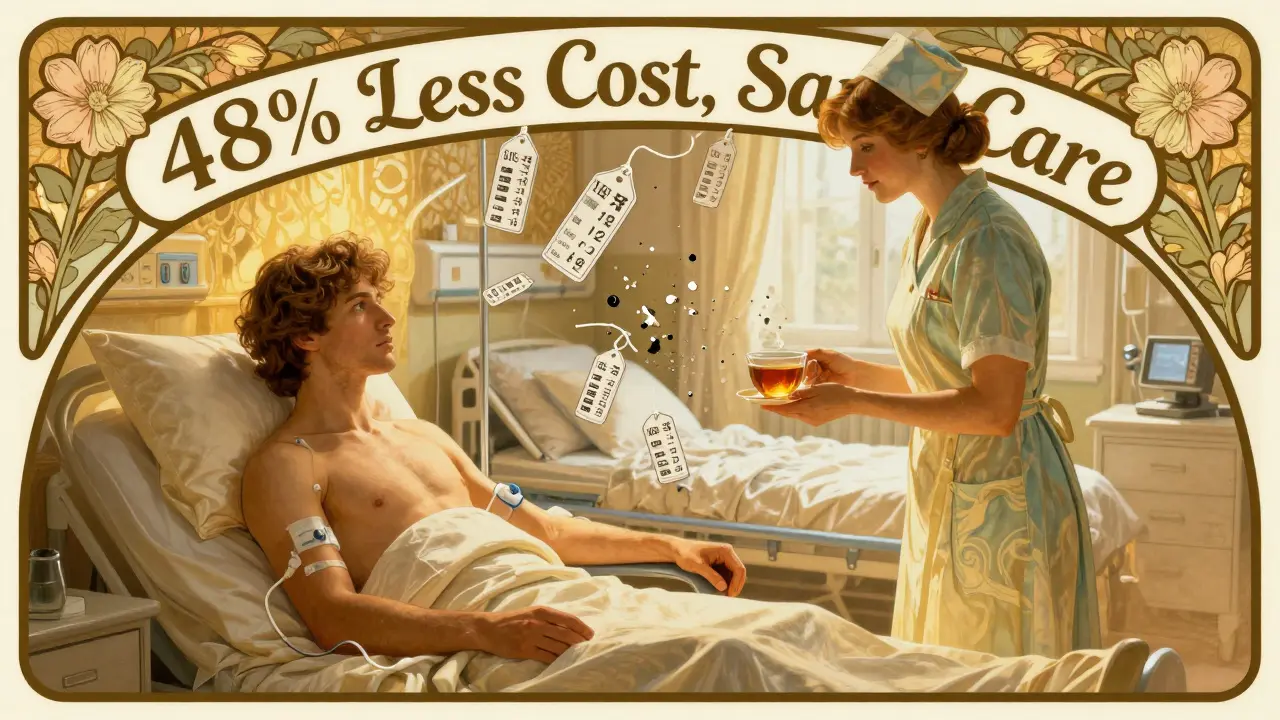
Many specialty injectables require infusion-think of someone sitting in a hospital chair for hours while a drug drips in. But hospitals charge 3-4 times more for this than a doctor’s office or home setting.Quantum Health studied 220 specialty drugs and found that 63% of the costs came from hospital-based infusions that didn’t need to be there. When they moved those treatments to medical offices or home care, costs dropped by 48%. That’s not a guess. That’s real data from 1.8 million patients.
How? First, identify which drugs can be safely given outside a hospital. Then, train staff. Set up fair reimbursement rates so clinics and home nurses are incentivized to participate. Finally, make it easy for patients: offer transportation help, home nursing support, and clear instructions. One employer saw adherence jump 12-15% after moving infusions home. People don’t miss work. They don’t wait in ERs. They get treated faster and cheaper.
Maximize Rebates and Financial Assistance Programs
Drug manufacturers offer copay assistance programs. Sounds great, right? But here’s the trap: if those payments count toward your deductible, you’re still paying more out of pocket. Worse, employers end up footing the bill indirectly.Copay maximizer programs fix this. They redirect manufacturer assistance to cover your plan’s share-not your deductible. That means patients pay $0 out of pocket-and your plan pays less too. CarelonRx found this strategy reduced employer costs by 5-8% annually.
But you need to work with your pharmacy benefit manager (PBM) to set it up. Ask: “Do you use maximizers? Can you show me how much we saved last year?” If they don’t offer it, push for it. And don’t forget: some patients qualify for government or nonprofit aid. Help them apply. A $500 monthly drug can become $0 with the right assistance.
Push for Value-Based Contracts
The old model? Pay for the drug, no matter the outcome. The new model? Pay only if it works.Value-based contracts tie drug payments to real-world results. For example: if a patient doesn’t improve after three months on a $10,000-a-month drug, the manufacturer refunds part of the cost. Prime Therapeutics reported a 45% jump in these contracts last year.
It’s not easy. It takes data, trust, and negotiation. But for high-cost drugs like cancer therapies or gene treatments, it’s worth it. One oncology program saved $2.1 million in six months by tying payments to tumor shrinkage rates. If you’re managing a large group plan, ask your PBM: “Do you have value-based contracts for specialty drugs? Can we pilot one?”
What Doesn’t Work
Some ideas sound smart but fall apart in practice.- Capping out-of-pocket costs helps patients but doesn’t lower overall spending. The drug still costs $10,000-you’re just shifting the bill to the plan.
- Shifting drugs from medical to pharmacy benefit works for 60-70% of specialty drugs, according to Quantum Health. But not all. Some injectables (like certain cancer infusions) are legally tied to medical benefits. Know the rules.
- Just asking patients to pay more leads to skipped doses, hospitalizations, and higher long-term costs. It’s cheaper to help them afford the drug than to treat the complications of skipping it.
Implementation Checklist
If you’re ready to act, here’s a practical roadmap:- Review your top 10 most expensive specialty drugs. Which ones have biosimilars? Which are given in hospitals?
- Ask your PBM: Do you use copay maximizers? Do you have a narrow specialty pharmacy network?
- Set up a Pharmacy & Therapeutics committee with a clinical pharmacist leading prior authorization reviews.
- Start transitioning infusion drugs to clinics or home settings. Pilot with 3-5 drugs first.
- Launch a biosimilar education campaign for prescribers and patients-use real cost examples.
- Track savings monthly. Aim for 5-7% reduction in the first year.
One employer in Texas cut specialty drug spending by 18% in 14 months using just four of these tactics. No layoffs. No patient backlash. Just smarter choices.
What’s Next?
By 2027, specialty drugs will cost $350 billion. Without action, that number will keep climbing. But the tools to fight back exist. Formularies, biosimilars, network control, home infusions, rebates, and value-based contracts-used together-can cut spending growth from 10-12% to just 5-7%.The future isn’t about denying care. It’s about delivering better care at a fair price. And that’s a goal worth working for.
Are biosimilars safe to use instead of brand-name biologics?
Yes. Biosimilars are approved by the FDA after rigorous testing to prove they’re highly similar to the original biologic in structure, safety, and effectiveness. They don’t contain new active ingredients. They’re not generics-they’re complex copies of complex drugs. Studies show no difference in outcomes for conditions like rheumatoid arthritis, Crohn’s disease, or cancer. In fact, hospitals that switched to biosimilars saw no drop in patient response rates and saved 20-30% on drug costs.
Why do some patients get denied access to specialty drugs?
Denials usually happen because of prior authorization rules designed to prevent inappropriate use-not to block care. For example, a GLP-1 drug might require proof of failed diet and exercise attempts before approval. Or a cancer drug might need a specific genetic test. These aren’t arbitrary. They’re based on clinical guidelines. The goal is to avoid spending thousands on a drug that won’t work for that patient. When done right, 98% of requests get approved.
Can I save money by switching my specialty pharmacy?
Yes, and it’s easier than you think. Specialty pharmacies negotiate different prices with drugmakers. One pharmacy might charge $1,200 for a drug, while another charges $900 for the same thing. If your plan uses a narrow network, you’ll automatically get the lower price. If you’re paying out-of-pocket, call your current pharmacy and ask for a cash price. Then call 2-3 others. You might save hundreds-even thousands-per month.
Is it better to get my injectable at a hospital or at home?
For most specialty injectables, home administration is safer, cheaper, and more convenient. Hospitals charge 3-4 times more for the same infusion. Studies show 91% of cases that moved to home or clinic settings saw a 48% cost drop-with no increase in complications. Home care also means less time away from work, fewer trips to crowded clinics, and better adherence. Insurance plans often cover home nursing. Ask your provider if your drug is eligible.
Do copay assistance programs really help lower costs?
It depends. Traditional copay cards help patients pay less upfront-but they often count toward your deductible. That means you’re still paying more later. Copay maximizers fix this. They redirect manufacturer money to cover your plan’s share instead of your out-of-pocket costs. This cuts your employer’s bill and leaves you with $0 out of pocket. Ask your plan: “Do you use maximizers?” If not, push for them. They’re one of the most effective tools we have.
Why are specialty drug prices rising so fast?
Specialty drugs are growing 10-12% per year-nearly triple the rate of regular prescriptions. Why? New drugs for rare diseases cost hundreds of thousands per year. Manufacturers set prices without competition. And there’s no system to compare value. A drug that extends life by 6 months might cost $500,000. Without rules to tie price to outcome, costs keep climbing. The solution isn’t price controls-it’s better contracts, biosimilars, and shifting how we pay.


