
How TRIPS Agreements Shape Global Access to Generic Medicines
Jan, 14 2026
When you buy a generic version of a life-saving drug like HIV antiretrovirals or hepatitis C treatment, you’re not just saving money-you’re benefiting from a global tug-of-war between patent rights and public health. At the center of this fight is the TRIPS agreement, a trade rule that changed how the world makes and distributes medicines. It was designed to protect innovation, but for millions in low-income countries, it became a barrier to survival.
What TRIPS Actually Does
The Trade-Related Aspects of Intellectual Property Rights (TRIPS) Agreement, created in 1995 under the World Trade Organization, forced every member country-164 of them-to adopt strict patent rules for pharmaceuticals. Before TRIPS, many developing nations didn’t even allow product patents on drugs. They could copy medicines made by foreign companies as long as they used a different manufacturing process. That’s how India became the pharmacy of the developing world: producing cheap generics of HIV drugs, cancer treatments, and antibiotics. TRIPS changed that. It required all countries to grant 20-year patents on drug products, not just processes. That meant once a company like Pfizer or Gilead patented a drug, no one else could make it-even if the original company charged $10,000 a year per patient and the cost to produce it was $100. The rule applied globally, no exceptions. Countries like Brazil, South Africa, and Thailand suddenly couldn’t make their own versions of life-saving drugs without risking trade sanctions.The Price Shock
The results were brutal. A 2001 study in the Journal of the American Medical Association found that after TRIPS took effect, prices for patented drugs jumped by more than 200% in developing countries. In South Africa, HIV drugs that cost $1,200 a year before TRIPS soared to over $10,000. For a country with limited healthcare budgets, that was impossible to afford. The same thing happened in Thailand when they tried to make their own versions of heart disease and cancer drugs-patent holders threatened legal action. In India, after switching to product patents in 2005, the price of some cancer drugs tripled overnight. The problem wasn’t just patents. TRIPS also introduced something called “data exclusivity.” Even after a patent expired, generic manufacturers couldn’t use the original company’s clinical trial data to prove their drug works. That meant they had to run expensive new trials-something most couldn’t afford. So even when the patent ran out, generics were delayed by 5 to 10 years. In some cases, patients waited longer for affordable versions than the original drug was even on the market.The Flexibility That Wasn’t
TRIPS wasn’t completely rigid. It had escape hatches. Article 31 lets governments issue “compulsory licenses”-allowing someone else to make a patented drug without the company’s permission, if it’s for public health. But there was a catch: the license had to be used mostly for the country’s own market. That meant if you were a small African nation with no drug factories, you couldn’t import cheaper generics made in India. You were stuck. In 2001, countries agreed to the Doha Declaration, which said public health matters more than patents. That was a win. But then came the “Paragraph 6 Solution” in 2005-a complicated workaround that let countries without manufacturing capacity import generics made under compulsory license. Sounds good? It didn’t work. Only two countries ever used it: Canada exported a small batch of HIV drugs to Rwanda in 2007. That’s it. The paperwork was too heavy, the legal risks too high. The system was designed to fail.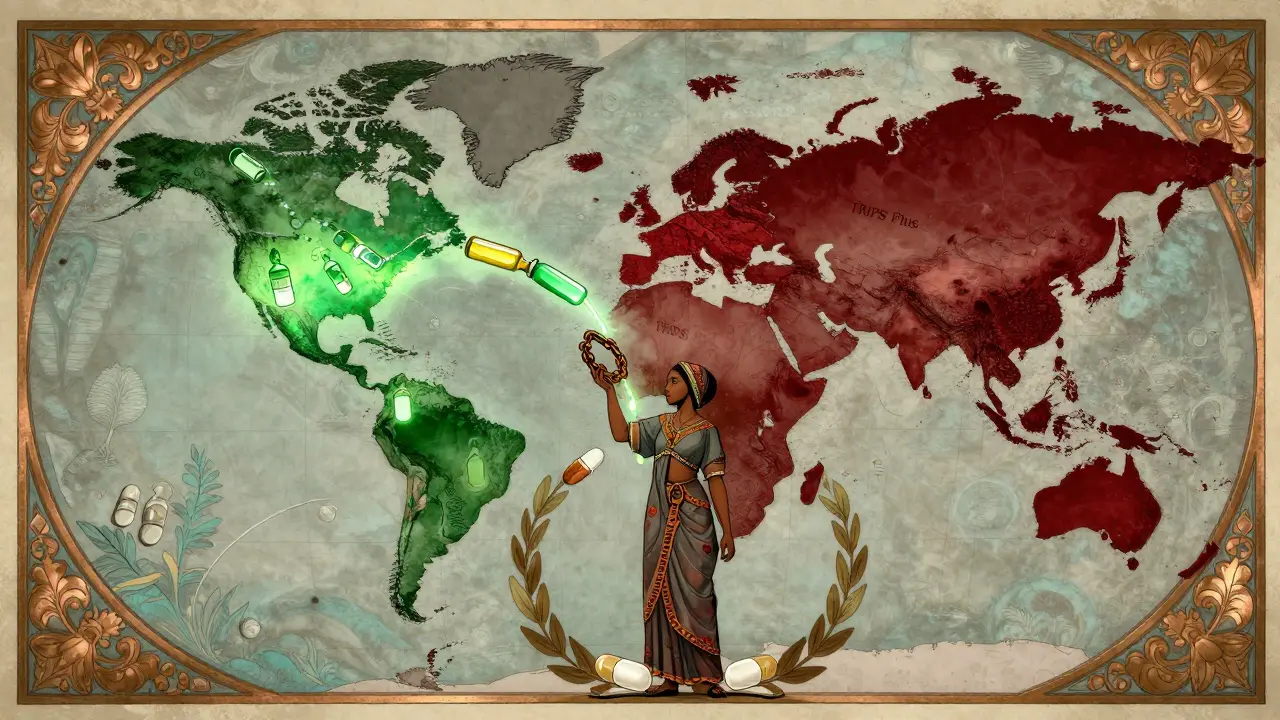
TRIPS Plus: The Hidden Rules
Even worse than TRIPS itself are the “TRIPS Plus” rules. These are extra patent protections pushed by the U.S., EU, and Switzerland through bilateral trade deals. They’re not part of the WTO agreement-but they’re just as binding. Countries signing free trade deals with the U.S. often have to agree to:- Extended patent terms (beyond 20 years)
- 8-10 years of data exclusivity
- Patent linkage (blocking generic approval until all patents are cleared)
- Restrictions on compulsory licensing
Who Wins and Who Loses
The pharmaceutical industry argues that strong patents are necessary for innovation. They point out that 73% of new drugs approved since 2000 came from companies in countries with strong IP laws. That’s true-but it ignores the other side. Between 1975 and 1997, only 13 out of 1,223 new drugs were developed for tropical diseases like malaria or sleeping sickness. Those are diseases that mostly affect poor people. No company saw a profit in them. So they weren’t invented. Meanwhile, the WHO found that 80% of medicines used in low-income countries are off-patent. But even those aren’t always available. Why? Because of supply chain issues, lack of regulatory capacity, or because local manufacturers can’t get financing. And when a new drug comes out-say, a new hepatitis C cure-generic versions are blocked for years, even though the cost to produce it is a fraction of the price. India still makes 60% of the world’s generic drugs. But even they’re feeling the pressure. U.S. trade pressure forced them to change patent laws. Now, they can’t just copy new drugs. Some Indian companies have shifted to making high-end generics or partnering with big pharma. Others are struggling.
What Changed After COVID
In 2020, India and South Africa asked the WTO to temporarily waive TRIPS protections for COVID-19 vaccines and treatments. Over 100 countries supported it. The U.S., EU, and Switzerland blocked it for over a year. Finally, in June 2022, the WTO agreed to a limited waiver-only for vaccines, not treatments, and only for low- and middle-income countries. It was a tiny crack in the wall. But the damage was done. By the time the waiver passed, most high-income countries had already secured billions of doses. Meanwhile, millions in Africa and Southeast Asia still hadn’t gotten their second shot. The waiver didn’t fix the system-it just showed how broken it is.Real Solutions Are Possible
There are working models. The Medicines Patent Pool, started in 2010, negotiates voluntary licenses with drug companies so generics can be made legally. So far, they’ve helped 17.4 million people get HIV, hepatitis C, and TB drugs. That’s real progress. But it relies on companies choosing to cooperate. It’s not a right-it’s a favor. Brazil managed to produce its own HIV drugs by using compulsory licensing and building local manufacturing. Thailand did the same for heart and cancer drugs. Both faced threats from the U.S., but they held their ground. They didn’t wait for permission-they acted. The lesson? Strong patent rules don’t create health. Strong health systems do. Countries that invested in local generic production, trained regulators, and refused to accept TRIPS Plus terms ended up with better access. Those that bowed to pressure? They paid the price in lives.What’s Next?
The battle over TRIPS isn’t over. New drugs for Alzheimer’s, cancer, and rare diseases are coming. Each one will be priced at $100,000 or more. If nothing changes, generics will be blocked for decades. The WHO says 65% of low-income countries now face delays in approving generics because of patent rules that go beyond TRIPS. The fix isn’t to scrap patents. It’s to fix the balance. Countries need to:- Reject TRIPS Plus clauses in trade deals
- Use compulsory licensing without fear
- Invest in local generic manufacturing
- Push for global funding to support generic production
- Require transparency in drug pricing and R&D costs
Does TRIPS ban generic drugs?
No, TRIPS doesn’t ban generics. It requires countries to grant 20-year patents on new drugs, which delays generic entry. But it allows compulsory licensing under specific conditions, meaning governments can still authorize generic production in emergencies. The problem isn’t the rule-it’s how hard it is to use the exceptions.
Why do some countries still make cheap generics?
Countries like India, Brazil, and Thailand still make generics because they either resisted full TRIPS compliance, used legal flexibilities like compulsory licensing, or built strong local manufacturing. India, for example, had a 2005 transition period to switch from process to product patents. Before that, it was the world’s largest supplier of low-cost medicines. Even after 2005, it kept producing generics for diseases where patents didn’t apply or were challenged in court.
Can a country import generics from another country under TRIPS?
Yes, but it’s extremely difficult. The 2007 WTO amendment allows it through the "Paragraph 6 Solution," but only if the importing country has no manufacturing capacity and the exporting country issues a compulsory license for export. Only one shipment of malaria medicine has ever been sent this way. The process is slow, bureaucratic, and risky-so most countries don’t try.
What’s the difference between a patent and data exclusivity?
A patent gives the original company exclusive rights to make and sell the drug for 20 years. Data exclusivity prevents generic companies from using the originator’s clinical trial data to prove their version is safe and effective. Even after the patent expires, generics can’t get approval for 5-10 more years because they’d have to run their own expensive trials. Data exclusivity is often the real barrier-not the patent.
Are generic drugs safe?
Yes. Generic drugs contain the same active ingredients as brand-name drugs and must meet the same quality standards. In fact, many generics used in the U.S. and Europe are made in the same factories as the originals. The difference is price, not safety. WHO and FDA both confirm that generics are equally effective and safe when properly regulated.


