
Pterygium: How Sun Exposure Fuels Eye Growth and What Surgery Can Do

Jan, 9 2026
If you’ve ever looked in the mirror and seen a pink, fleshy wedge growing from the white of your eye toward your pupil, you’re not alone. This isn’t a rare oddity-it’s pterygium, commonly called "Surfer’s Eye." And if you live where the sun shines hard and often, like in Australia, you’re at higher risk than most. It’s not cancer. It’s not an infection. But left unchecked, it can blur your vision, make wearing contacts impossible, and leave your eye looking red and irritated for years.
What Exactly Is Pterygium?
Pterygium starts on the conjunctiva-the clear, thin tissue that covers the white part of your eye. From there, it creeps forward like a tiny wing, slowly growing onto the cornea, the clear dome that protects your iris and pupil. The name comes from the Greek word for "little wing," and it’s easy to see why: the growth looks like a triangular flap of tissue, often with visible tiny blood vessels running through it. It’s most common on the side of the eye closest to your nose-about 95% of cases show up there. And it doesn’t always happen in just one eye. Around 60% of people with pterygium have it in both eyes, especially if they’ve spent decades outdoors without eye protection. In Australia, nearly 1 in 8 men over 60 have it. That’s not a small number. It’s a direct result of living under a strong sun, with low ozone levels and long hours outside.Why Does the Sun Cause This?
Ultraviolet (UV) radiation is the main driver. It’s not just about getting a tan-it’s about cumulative damage. Studies show that people who’ve been exposed to more than 15,000 joules of UV energy per square meter over their lifetime have a 78% higher chance of developing pterygium. That’s roughly the amount you get from 10 years of daily outdoor work or recreation without sunglasses. You don’t need to be a surfer to get it. Farmers, construction workers, fishermen, even gardeners in Adelaide or Brisbane are at risk. UV light triggers inflammation and abnormal cell growth in the conjunctiva. Over time, this leads to fibrovascular tissue spreading onto the cornea. The more sun you get, the faster it grows-typically between 0.5 and 2 millimeters per year. Some cases stay still for decades. Others creep forward quickly, especially in tropical zones. It’s worth noting: pterygium is not the same as pinguecula. A pinguecula is a yellowish bump on the conjunctiva, but it never crosses onto the cornea. Think of pinguecula as the warning sign, and pterygium as the full-blown condition. About 70% of outdoor workers in hot climates get pinguecula. Only 30% go on to develop pterygium. That means prevention works-if you act early.When Does It Become a Problem?
Many people have small pterygia and never notice them. They might see a bit of redness or feel like there’s something in their eye, but they brush it off as dryness. The real trouble starts when the growth gets close to the pupil. At that point, it can distort the shape of your cornea, causing astigmatism. Your vision gets blurry, even with glasses. You might find contact lenses uncomfortable or impossible to wear. Some patients report a constant gritty feeling, like sand is stuck in their eye. In advanced cases, the growth can block light from entering the eye. That’s when it’s no longer just a cosmetic issue-it’s a vision threat. The American Optometric Association says if the pterygium extends far enough onto the cornea, it can interfere with your sight. And once it does, conservative treatments won’t fix it.Can You Stop It Before It Gets Worse?
Yes. And it’s simpler than you think. The first rule: block the UV. Wear sunglasses that block 99-100% of UVA and UVB rays. Look for labels that say they meet ANSI Z80.3-2020 standards. Wraparound styles are best-they stop UV from sneaking in from the sides. Pair them with a wide-brimmed hat. That combo cuts UV exposure to your eyes by up to 80%. Use lubricating eye drops if your eyes feel dry or irritated. Preservative-free artificial tears are gentler and better for long-term use. Since March 2023, a new product called OcuGel Plus has been available in Australia and the U.S. It’s specifically designed for pterygium patients and was shown in trials to relieve symptoms 32% better than standard drops. And here’s the key: get checked every year if you’re over 40 and spend time outdoors. Your optometrist can spot early changes with a simple slit-lamp exam. No blood tests. No scans. Just a bright light and magnification. Early detection means you can stop progression before surgery becomes necessary.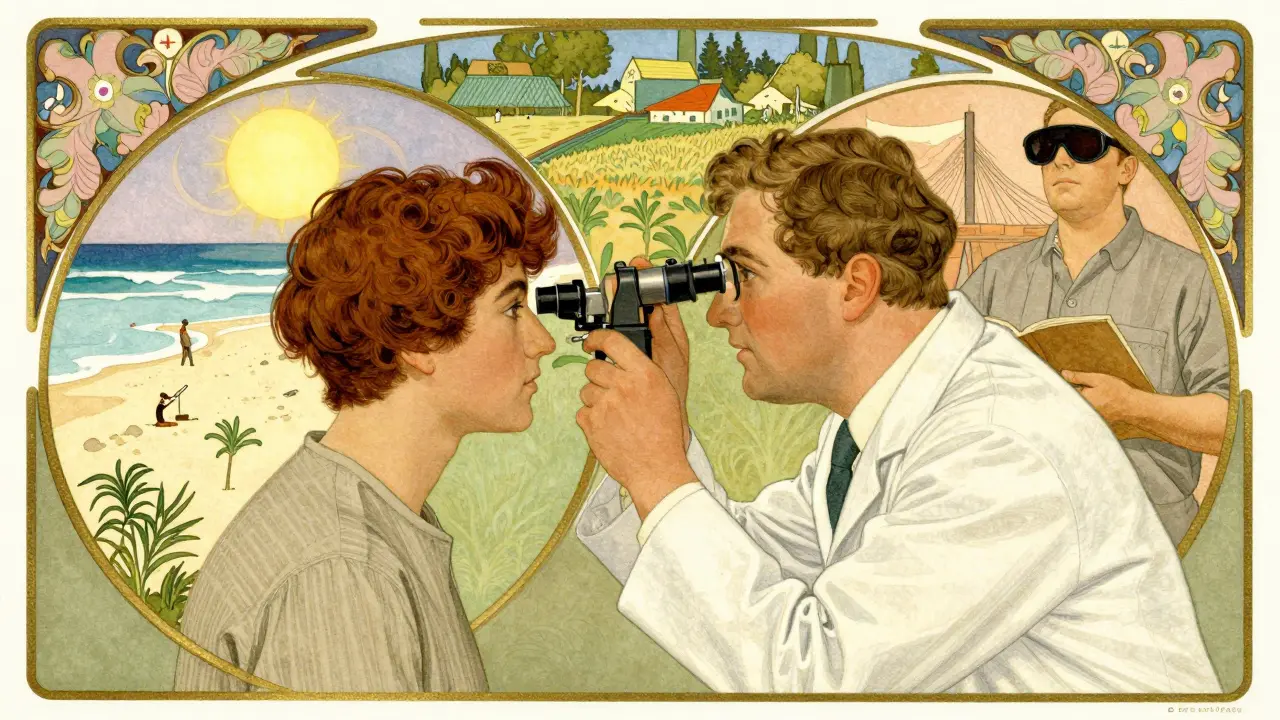
When Is Surgery Needed?
Surgery isn’t the first step. Most doctors recommend waiting until the pterygium is causing vision problems, significant discomfort, or cosmetic distress. But if you’ve tried everything and it’s still growing, or if it’s already covering your pupil, surgery is the only option. The most common procedure today is called a conjunctival autograft. Here’s how it works: the surgeon removes the pterygium tissue, then takes a small piece of healthy conjunctiva from another part of your eye-usually near the top-and stitches it over the bare spot. This acts like a biological bandage, reducing the chance of regrowth. To make it even more effective, surgeons often apply mitomycin C during the surgery. This is a mild chemotherapy drug that stops abnormal cells from coming back. Without it, recurrence rates are 30-40%. With it, they drop to 5-10%. A newer option, approved by European eye specialists in June 2023, is amniotic membrane transplantation. This uses tissue from donated placenta to cover the area after removal. It’s especially useful for recurrent cases, with success rates above 90% in preventing regrowth.What Happens After Surgery?
Recovery isn’t quick, but it’s manageable. You’ll need steroid eye drops for 6 to 8 weeks. These reduce inflammation and help prevent recurrence. Many patients say the drops are harder to stick with than the surgery itself. They burn at first. They’re expensive. You have to remember to use them multiple times a day. Your eye will be red and swollen for 2-3 weeks. Some people report mild pain or sensitivity to light. Most return to normal activities within a week, but you should avoid swimming, dusty environments, and direct sun for at least a month. About 32% of patients report regrowth within 18 months, especially if they don’t wear sunglasses after surgery. That’s why post-op care is just as important as the procedure.What Are the Alternatives?
Not everyone chooses surgery. Some people manage pterygium with drops, hats, and sunglasses for years. Others opt for laser treatment, though it’s not widely used yet. A Phase II clinical trial (NCT05214387) is testing topical rapamycin-an immune-modulating drug-to stop fibroblast growth. Early results show a 67% reduction in recurrence compared to placebo. It’s not approved yet, but it’s promising. Laser-assisted removal is also on the horizon. By 2027, experts predict 78% of ophthalmologists will use lasers for pterygium removal. The goal is to make it less invasive, reduce scarring, and speed up healing.Who’s Most at Risk?
Men are more likely to develop pterygium than women-about 3 in 5 cases. That’s likely because more men work outdoors in high-UV environments. The risk skyrockets if you live within 30 degrees of the equator. In Australia, 23% of adults over 40 have it. That’s the highest rate in the world. People over 40 are most affected, but younger people who spend a lot of time in the sun without protection are catching up. Surfers, construction workers, farmers, and even kids who play outside without sunglasses are now showing up with early signs.
How Common Is This?
Globally, pterygium is the third most common eye surface disorder after cataracts and glaucoma. About 15 million people are diagnosed every year. The market for treatments is growing fast-projected to hit $1.89 billion by 2028. That’s because more people are living longer, spending more time outdoors, and awareness is increasing. In Australia, it’s not just a health issue-it’s a public health concern. With ozone depletion and climate change, UV levels are rising. More people will need treatment in the next decade.What Should You Do Now?
If you’ve noticed a pink or red growth on your eye:- Don’t panic. It’s not cancer.
- Wear UV-blocking sunglasses and a wide-brimmed hat every day, even when it’s cloudy.
- Use preservative-free artificial tears if your eyes feel dry or gritty.
- Book an eye exam with an optometrist or ophthalmologist. Get a slit-lamp check.
- If it’s small and not affecting your vision, focus on prevention. UV protection can stop it from growing.
- If it’s growing toward your pupil or blurring your vision, talk to a specialist about surgery.


