
How Generics Save Trillions in Healthcare: The Real Cost Impact
Feb, 23 2026
Every year, Americans fill over 3.9 billion prescriptions. Nine out of ten of those are for generic drugs. Yet, those same generics make up barely 12% of total drug spending. That’s not a coincidence. It’s the result of a system that works - when it’s not blocked.
In 2024, generic and biosimilar medications saved the U.S. healthcare system $467 billion. That’s not a typo. That’s half a trillion dollars in one year. Over the last decade, those savings have added up to $3.4 trillion. Think about that: enough to cover the entire annual budget of the Department of Defense - and still have billions left over. This isn’t theoretical. This is real money saved by real people paying less for their blood pressure pills, insulin, and cholesterol meds.
How Generics Cut Costs So Deeply
Generic drugs aren’t cheaper because they’re low quality. They’re cheaper because they don’t need to pay for research, clinical trials, or marketing. Once a brand-name drug’s patent expires, other companies can make the exact same medicine. The FDA requires them to prove they work the same way, in the same amount, in the same body. That’s it. No extra cost. No magic. Just competition.
Here’s the math: In 2024, Americans spent $98 billion on generics. On brand-name drugs? $700 billion. That’s more than seven times more - for the same active ingredients. Why? Because brand companies hold monopolies for years, often using legal tricks to delay generics. When that monopoly finally breaks, prices drop fast. A single generic version can slash a drug’s price by 80%. Add a second or third generic, and it can fall to 95% below the original price.
The biggest savings come from the most commonly used drugs. Take metformin for diabetes, lisinopril for high blood pressure, or atorvastatin for cholesterol. In 2023, the top 10 generic drugs saved $89.5 billion just from their volume. The 10 with the highest total savings? They saved $127 billion - nearly a third of all generic savings that year. These aren’t rare specialty drugs. They’re the medicines millions take every day.
Biosimilars: The Next Wave of Savings
Biosimilars are the next frontier. Unlike traditional generics, they’re not exact copies - they’re highly similar versions of complex biologic drugs made from living cells. These include drugs for cancer, rheumatoid arthritis, and Crohn’s disease. They used to cost over $100,000 a year. Now, biosimilars are bringing those prices down by 30% to 60%.
Since the first biosimilar entered the U.S. market in 2015, they’ve saved $56.2 billion. In 2024 alone, they saved $20.2 billion. That’s a lot - and it’s just the start. The FDA approved 17 new biosimilars in 2024, and more are coming. By 2030, biosimilars could save the system another $100 billion. The challenge? Slow adoption. Many doctors and patients still think biosimilars are riskier. But data shows they’re just as safe and effective. The biggest barrier isn’t science - it’s perception.
Why Some States Save More Than Others
Savings aren’t spread evenly. California saved nearly $38 billion in 2023. Alaska? Just $600 million. Why? Population size matters, but so do state laws. California forces pharmacies to substitute generics unless the doctor or patient says no. That’s called mandatory substitution. It’s one reason why 98% of prescriptions there are filled with generics.
Texas, on the other hand, lets pharmacists substitute - but doesn’t require it. As a result, only 87% of prescriptions there are generic. That 11-point gap? It adds up to billions. States with strong substitution laws, like New York and Massachusetts, consistently outperform those with weak or no rules. The lesson? Policy drives behavior. When the system is designed to push generics, people use them.
The Hidden Costs: How Big Pharma Blocks Savings
For all the savings, the system is still broken. Brand drug makers have spent decades inventing ways to keep generics out. One trick? Patent thickets. Instead of one patent, they file dozens - on packaging, dosage forms, even manufacturing methods. The goal? To stretch their monopoly beyond the original 20-year limit. A JAMA Health Forum study found that just four drugs, protected by these thickets, cost the system over $3.5 billion in two years.
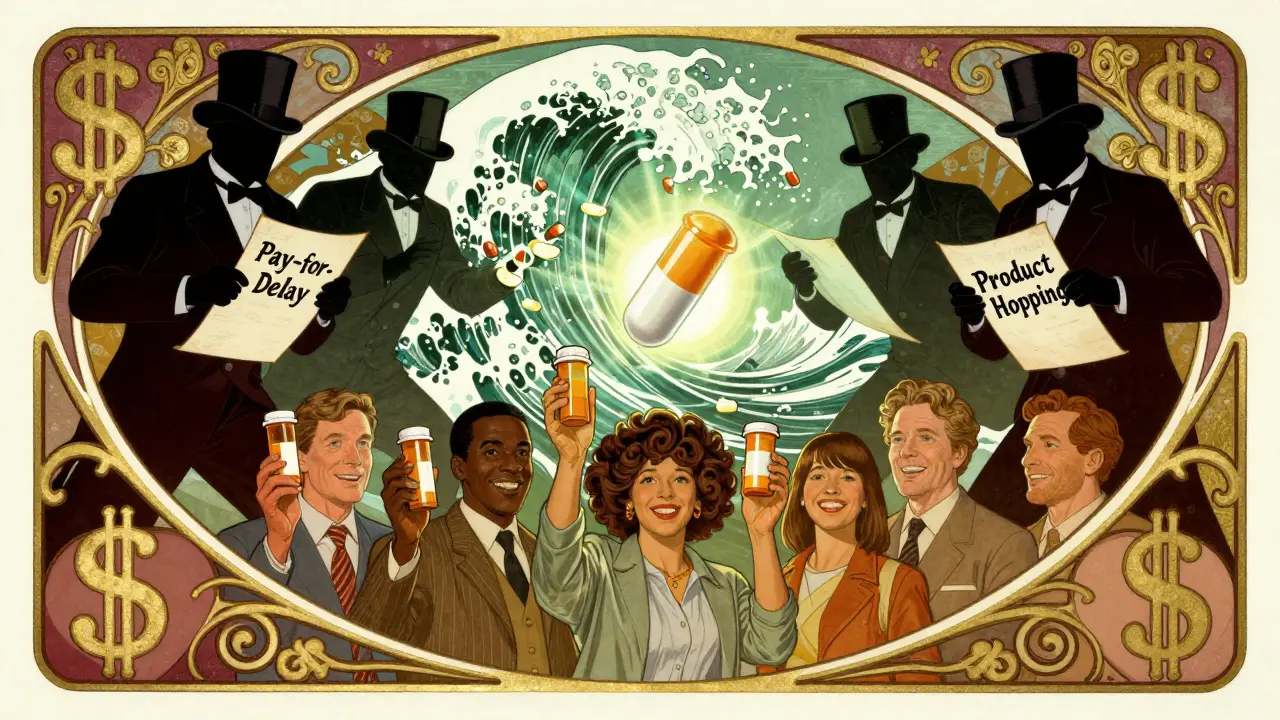
Another tactic? Pay-for-delay. Sometimes, brand companies pay generic makers to delay launching their cheaper version. In 2023, Blue Cross Blue Shield estimated these deals cost $12 billion a year. About $3 billion of that hit Medicare and Medicaid. The Congressional Budget Office says ending these deals would save $1.1 billion over ten years. That’s money that could pay for cancer treatments, mental health care, or insulin for thousands.
Then there’s product hopping. A company changes a drug’s form - say, from a pill to a capsule - and patents the new version. Patients are then pushed to the new, expensive version. The old one gets discontinued. It’s legal. It’s unfair. And it happens often.
Who’s Really Saving Money?
Medicare saved $142 billion on generics in 2024. Medicaid saved $62.1 billion. That’s not just numbers - it’s people who didn’t have to choose between medicine and rent. Private insurers saved even more. Express Scripts, one of the largest pharmacy benefit managers, generated $18.3 billion in savings in 2023 by steering patients toward generics.
But here’s the twist: patients still pay too much. Even with generics, out-of-pocket costs can be high. Why? Because insurance plans often don’t pass savings along. A 2023 survey found that 42% of patients abandoned prescriptions due to cost. But among those who switched to generics? 89% said they were satisfied with both cost and effectiveness. The average monthly savings? $147 per medication. That’s over $1,700 a year for one drug. Enough to cover a month’s rent in many places.
What’s Holding Back the Next Wave?
More generics are being approved than ever. The FDA approved 1,145 in 2024 - up 7.3% from the year before. But shortages are rising. In December 2024, 287 generic drugs were in short supply. Many are simple, essential medicines - antibiotics, painkillers, IV fluids. Why? Manufacturing is concentrated. Just ten companies make 63% of all generics. If one factory shuts down, supply chains break.
Another problem? Pharmacy Benefit Managers (PBMs). These middlemen control which drugs are covered and at what price. Some PBMs profit more from brand drugs because they get bigger rebates. So even when a generic is cheaper, they may steer patients toward the brand. It’s not always clear to patients. And it’s not always legal - but enforcement is weak.
Then there’s the bureaucracy. Prior authorization for generics? It went up 47% between 2019 and 2023. That means pharmacists have to call doctors, wait for approval, and delay the fill. For a $5 generic, that’s a ridiculous barrier. It’s like putting a toll booth on the highway to savings.
The Future: $5.1 Trillion in Savings by 2034
If current trends hold, generics and biosimilars will save $5.1 trillion between 2025 and 2034. That’s not a guess. It’s a projection from IQVIA, based on approved drugs and pending patents. But it’s only possible if we fix the system. The Affordable Prescriptions for Patients Act, passed by the Senate HELP Committee in 2024, targets patent abuse and pay-for-delay. If it becomes law, it could add $7.2 billion in annual savings.
The tools are already here. The science is proven. The data is clear. We know how to save money. We know how to make medicine affordable. The question isn’t whether we can - it’s whether we will. Because every time a patient can’t afford their pill, the system fails. And every time a generic reaches the pharmacy shelf, it’s a win.
Are generic drugs really as effective as brand-name drugs?
Yes. The FDA requires generics to have the same active ingredient, strength, dosage form, and route of administration as the brand-name drug. They must also be bioequivalent - meaning they work the same way in the body. Studies show that 90% of patients respond the same to generics as to brands. A Drugs.com review of over 15,000 users found that 87% rated cost as excellent or good, and 63% rated effectiveness as excellent or good. While some patients report differences, these are often due to inactive ingredients, not the medicine itself.
Why do some pharmacies push brand-name drugs over generics?
Some Pharmacy Benefit Managers (PBMs) profit more from brand drugs because they receive larger rebates. Even if a generic is cheaper, the PBM may steer the patient toward the brand to collect a higher rebate from the manufacturer. This isn’t always transparent to patients or doctors. Additionally, some insurance plans have formularies that favor brand drugs unless the doctor writes "do not substitute."
How much can I save by switching to a generic drug?
On average, switching to a generic saves patients $147 per month per medication. For common drugs like metformin or lisinopril, savings can be over $90% off the brand price. A 30-day supply of brand-name Lipitor might cost $300 - the generic atorvastatin costs $10 or less with insurance. That’s over $3,500 a year saved on one drug alone.
Do biosimilars work as well as biologics?
Yes. Biosimilars are not exact copies, but they are highly similar to the original biologic drug, with no clinically meaningful differences in safety, purity, or potency. The FDA approves them only after rigorous testing. Since 2015, biosimilars have been used by millions of patients with no safety concerns. They’ve cut costs for drugs like Humira and Enbrel by 30-60%, and more are coming.
Why are generic drug shortages happening?
Most generic drugs are made in just a few countries - primarily India and China. Manufacturing is concentrated, and when one plant has issues - due to inspections, supply chain delays, or quality problems - shortages follow. Also, low profit margins mean some manufacturers stop making certain generics if they’re not profitable enough. In December 2024, 287 generic drugs were on the FDA’s shortage list, including common antibiotics and heart medications.


