
How to Transport Medications in Hot and Cold Weather: A Practical Guide for Patients and Travelers

Jan, 22 2026
Imagine this: you’re on a road trip in the Australian outback, and your insulin is sitting in the glove compartment while the temperature outside hits 42°C. Or maybe you’re flying to Melbourne in winter, and your vaccine sits in an unheated baggage hold for hours. In both cases, your medication could be ruined-without you even knowing it.
Medications aren’t like groceries. You can’t just toss them in a bag and forget about them. Heat and cold don’t just make them uncomfortable-they can destroy their effectiveness. And once that happens, you’re not just wasting money. You’re risking your health.
The good news? You don’t need a PhD in logistics to keep your meds safe. You just need to know what to do-and what not to do.
Why Temperature Matters More Than You Think
Not all medications are the same. Some can handle a hot car. Others? One hour above 25°C and they’re done.
Insulin, for example, starts breaking down at 25°C. Every hour above that, it loses about 1.2% of its potency. After 6 hours in a hot car? That’s nearly 7% gone. You might not feel it right away-but your blood sugar will. And when you need it most, it won’t work like it should.
Vaccines like MMR or flu shots lose 10% potency per hour above 8°C. That’s not a small drop. That’s the difference between protection and vulnerability.
Even antibiotics can turn useless. Some lose all effectiveness after just 30 minutes above 40°C. And once they’re degraded? No lab test can bring them back.
The problem isn’t just extreme heat. Cold is just as dangerous. Freezing insulin? It clumps. It turns cloudy. It stops working. Same with many biologics and injectables. Even if the package says "refrigerate," that doesn’t mean "freeze."
The Three Temperature Zones You Need to Know
Pharmaceuticals fall into three main temperature buckets. Know which one your meds belong to.
- Ambient (15°C-25°C): Most pills, capsules, and some creams. These are the least sensitive. Still, don’t leave them on a dashboard in summer.
- Refrigerated (2°C-8°C): Insulin, many vaccines, biologics, some eye drops, and injectables. These need to stay cool-but never frozen.
- Cryogenic (below -150°C): Rare. Mostly specialized vaccines like some mRNA shots. These require dry ice or liquid nitrogen. Most people won’t handle these personally.
If your medication’s label says "store between 2°C and 8°C," that’s your zone. If it says "store at room temperature," assume that means 15°C-25°C. If you’re unsure, call your pharmacist. Don’t guess.
How to Transport Medications in Hot Weather
Summer in Adelaide hits 40°C. Your car? It’s an oven. Your backpack? A sauna. Here’s how to fight back.
- Never leave meds in the car. Even with the windows cracked. The interior of a parked car can hit 60°C in under 20 minutes.
- Use an insulated cooler bag. A standard lunch bag with two frozen gel packs can keep insulin or vaccines at 2°C-8°C for up to 8 hours in 35°C heat. Buy one designed for meds if you can-like the TempAid 2.0. It’s heavier, but it works.
- Keep it on your person. Carry your meds with you. In a purse, backpack, or even a fanny pack. Your body heat helps buffer extreme temps.
- Use ice packs, not ice. Ice melts and creates water. Water can ruin labels, leak into blister packs, and cause contamination. Use gel packs or phase-change materials designed for pharmaceuticals.
- Plan your stops. If you’re driving, keep your meds in the cabin. If you’re flying, carry them in your hand luggage. Never check them.
Pro tip: If you’re flying, ask the airline if they offer temperature-controlled baggage options. Some do-for a fee. It’s worth it if you’re carrying expensive biologics.
How to Transport Medications in Cold Weather
Winter’s tricky too. You think cold is safe? Not if your meds freeze.
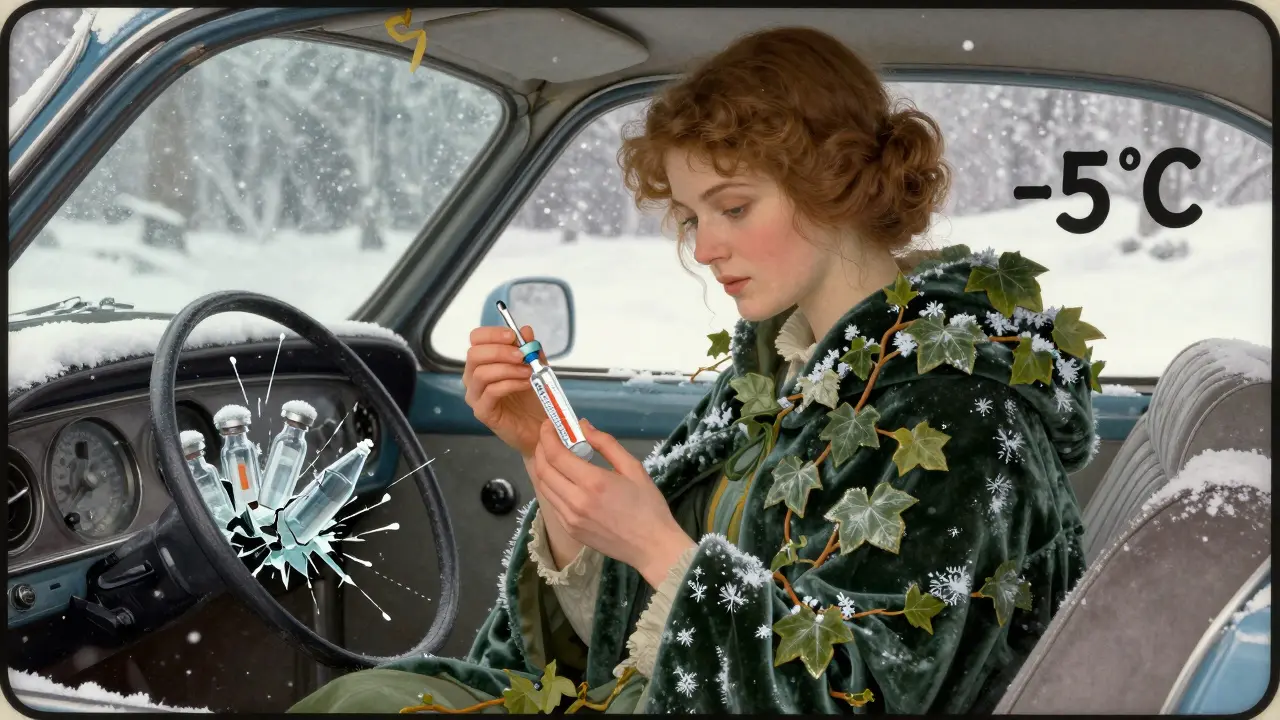
When temperatures drop below 0°C, refrigerated meds can freeze. Insulin freezes at around -1°C. Once frozen, it’s ruined. Even if it thaws, the structure is broken.
- Don’t leave meds in the trunk. Trunks get colder than the cabin. Even in a car with heat, the trunk can drop below freezing overnight.
- Keep meds inside the cabin. Put them on your seat, in your coat pocket, or near your body. Your warmth helps.
- Wrap them in a towel or sweater. Insulation works both ways. A cloth wrap slows down heat loss and prevents freezing.
- Avoid direct contact with cold surfaces. Don’t let your med bag sit on the floor of a cold car. Use a foam pad or insulated liner.
- For long trips in extreme cold, use thermal blankets. These are used by hospitals and logistics companies. They’re cheap, reusable, and keep meds from freezing for hours.
One real story: A patient in Tasmania left her insulin in her car overnight when it hit -5°C. The vial froze. She didn’t know. She used it the next day. Her blood sugar spiked. She ended up in hospital. It took weeks to recover.
What Not to Do
Here are the mistakes people make-over and over.
- Using a regular cooler without gel packs. A cooler alone won’t keep things cold. It just slows warming. You need active cooling.
- Assuming "room temperature" means any temperature. Room temperature isn’t "whatever the weather is." It’s 15°C-25°C. If it’s 30°C outside, that’s not room temp.
- Ignoring the last mile. 43% of temperature excursions happen during final delivery-when the package sits on a porch for an hour. If you’re expecting a delivery, be home to receive it.
- Using expired or non-medical cooling products. A cheap ice pack from the supermarket might leak or not hold temperature long enough. Use ones labeled for pharmaceutical use.
- Not checking your meds before use. If insulin looks cloudy, has particles, or changed color? Don’t use it. Throw it out. Your pharmacist can help you replace it.
What to Carry When You Travel
Traveling? Pack smart.
- Carry-on only. Always. Never checked luggage. Airlines lose bags. They also expose them to extreme cold in cargo holds.
- Bring extra. If you need one vial of insulin a day, bring three. If you’re on a 10-day trip, bring 14. Things break. Things get lost. Always have a backup.
- Bring a copy of your prescription. In case you’re questioned at security or customs. Some countries have strict rules about meds.
- Use a digital thermometer. Small, battery-powered ones cost under $20. Clip it to your bag. Check it before you use your meds.
- Label everything. Write your name, medication name, and temperature range on the outside of your bag. If someone finds it, they’ll know what to do.

Monitoring and Documentation
Most people don’t think about tracking. But if your meds get damaged, you need proof.
Real-time temperature loggers are now affordable. Some connect to your phone via Bluetooth. They record every 15 minutes. If your insulin was exposed to 32°C for 2 hours, the device will show it. That’s critical if you need to claim a replacement from your pharmacy or insurer.
Even if you don’t use a device, write it down. Note the time, location, and conditions. Did your meds sit in a hot car for 45 minutes? Write it. That info could save your life later.
Pharmacies and insurers require documentation for replacements. Without it, you’re out of luck.
What to Do If Your Medication Gets Damaged
If you suspect your meds were exposed to bad temps:
- Don’t use them. Even if they look fine.
- Call your pharmacist immediately. They can tell you if it’s safe based on the type of med and exposure time.
- Ask for a replacement. Many pharmacies and manufacturers will replace damaged meds if you have documentation.
- Report it. If it happened during shipping, report it to the courier. If it happened in a hospital or clinic, report it to their quality team.
There’s no shame in this. Temperature damage happens to everyone-even hospitals. What matters is what you do next.
The Bottom Line
Transporting medications in extreme weather isn’t optional. It’s essential.
You don’t need fancy gear. You don’t need to be an expert. You just need to be aware. A $15 insulated bag. A gel pack. A little planning. That’s all it takes.
And if you’re ever unsure? Ask your pharmacist. They’ve seen it all. They’ll tell you exactly what to do.
Your meds are your lifeline. Treat them like it.


